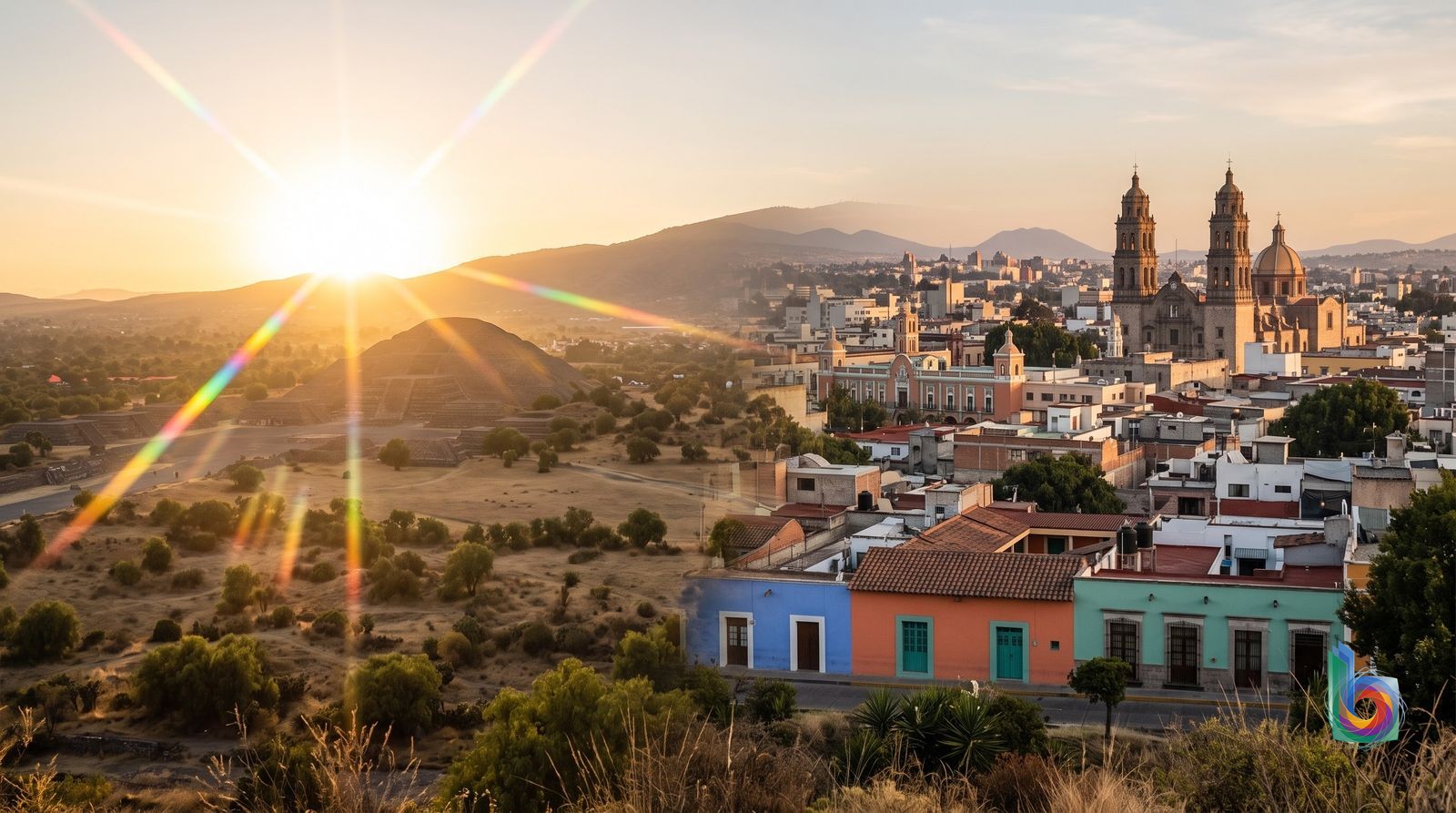
Teotihuacán is a superb half-day archaeological visit if you can handle 2–4 km of exposed, sometimes uneven walking. It works best with an opening-time arrival and enough time to walk the full ceremonial axis rather than treating it as a quick pyramid photo stop.
Arrive at 08:00 and buy official entry
Buy same-day admission at an official taquilla on arrival, especially on weekends, holidays and in March; INAH has not published a normal timed-entry sell-out system.
MoreStart at Gate 1
For a first full visit, enter at Puerta 1 and walk north through the Ciudadela, Temple of the Feathered Serpent, Avenue of the Dead, Sun Pyramid and Moon Plaza.
MoreAllow four to five hours
A proper independent visit needs 4–5 hours for the core monuments, Ciudadela, museums and a mural or residential stop; a rushed two-hour visit misses much of the city’s scale.
MorePack water, sun protection and light bags
There is little shade and 11:30–15:30 is the hottest period; food, drones, bicycles, smoking and bulky items may be prohibited or restricted at entry.
MoreArchaeological Zone core
~240 min · General daytime admission; Puertas 1–5 serve different parts of the visitor circuit.
Museum of Teotihuacan Culture
Included with archaeological-zone admission; closest to Puerta 5 and included on the accessible route from Puerta 4.
Museum of Teotihuacan Murals
Included with archaeological-zone admission; near Puerta 3 and available as an optional accessible-route extension.
Teotihuacán is the monumental archaeological core of a vast pre-Hispanic city in Mexico’s Valley of Mexico, occupied principally between the 1st and 7th centuries CE. At its height it may have held 100,000–200,000 people in more than 2,000 apartment compounds; its carefully planned ceremonial center includes the Avenue of the Dead, Pyramid of the Sun, Pyramid of the Moon, Ciudadela, and Temple of the Feathered Serpent. The name is a later Nahuatl term used by the Mexica; the city’s original name and inhabitants’ language remain unknown.
This is one of the Americas’ great ancient urban landscapes: walking its roughly two-kilometre ceremonial axis makes the pyramids, plazas, sculpture, murals, and residential city read as a deliberately designed metropolis rather than isolated monuments. It rewards archaeology, art, and urbanism enthusiasts, and deserves at least a half-day; skip or reconsider if you cannot manage 2–4 km on exposed, sometimes uneven ground, are sensitive to heat or altitude, or only have a rushed two-hour window. Do not visit expecting to climb the Pyramid of the Sun, as climbing is prohibited.
The archaeological zone is open daily, including holidays, 08:00–17:00; final entry is at 16:30. Arrive around 08:00–08:30, especially on weekends, holidays, or in March. INAH advises arriving between 08:00 and 09:00, and notes that 11:30–15:30 is the hottest part of the day. Do not plan for sunset: the site closes at 17:00.
Standard admission is MX$210 per adult and includes the archaeological zone and site museums. Mexican nationals and foreign residents of Mexico pay MX$105 with valid official identification proving status. Children under 13, adults over 60 with credentials, people with disabilities, credentialed students and teachers, and several other qualifying groups enter free; Mexican citizens and Mexico residents with proof enter free on Sundays. Bring the original official ID or credential needed for any discount or free entry.
Usually, no advance purchase is necessary for ordinary daytime entry. INAH says tickets are sold at archaeological-zone ticket offices and through its official web channel, but it does not publish timed-entry slots, an advance-release schedule, or a normal sell-out policy. For a regular visit, arrive at opening and buy at an official taquilla. Do not pay a reseller a markup just for basic admission if official online tickets are unavailable. Expect queues and tighter parking on Sundays, public holidays, school-vacation dates, and around the spring equinox.
Allow 2–2.5 hours only for a concise highlights visit: Moon Plaza, Pyramid of the Sun exterior, part of the Avenue of the Dead, plus either the Ciudadela or one museum. A strong independent visit takes 4–5 hours and allows time for the full central axis, Ciudadela and Temple of the Feathered Serpent, both museums, and a mural or residential-complex stop. INAH’s general recommended range is 3–5 hours.
Do not expect to climb the Pyramid of the Sun: climbing is prohibited. The Pyramid of the Moon reopened for limited ascent in May 2025, but only to its first level and subject to staff restrictions. Treat any ascent as conditional rather than a guaranteed part of your visit.
For a first full visit, use Puerta 1 at the south end and walk north through the Ciudadela, Temple of the Feathered Serpent, Avenue of the Dead, Pyramid of the Sun, and Moon Plaza; exit near Puerta 3. Use Puerta 2 for a shorter pyramid-focused visit. Puerta 4 is the recommended start for the step-free accessible route. Use Puerta 5 if the Museum of Teotihuacan Culture is a priority or if arriving by the main highway approach. INAH’s map labels gates 1–5 but does not give separate street addresses, so give a driver the gate number and landmark. and https://visitateotihuacan.inah.gob.mx/en/explore/