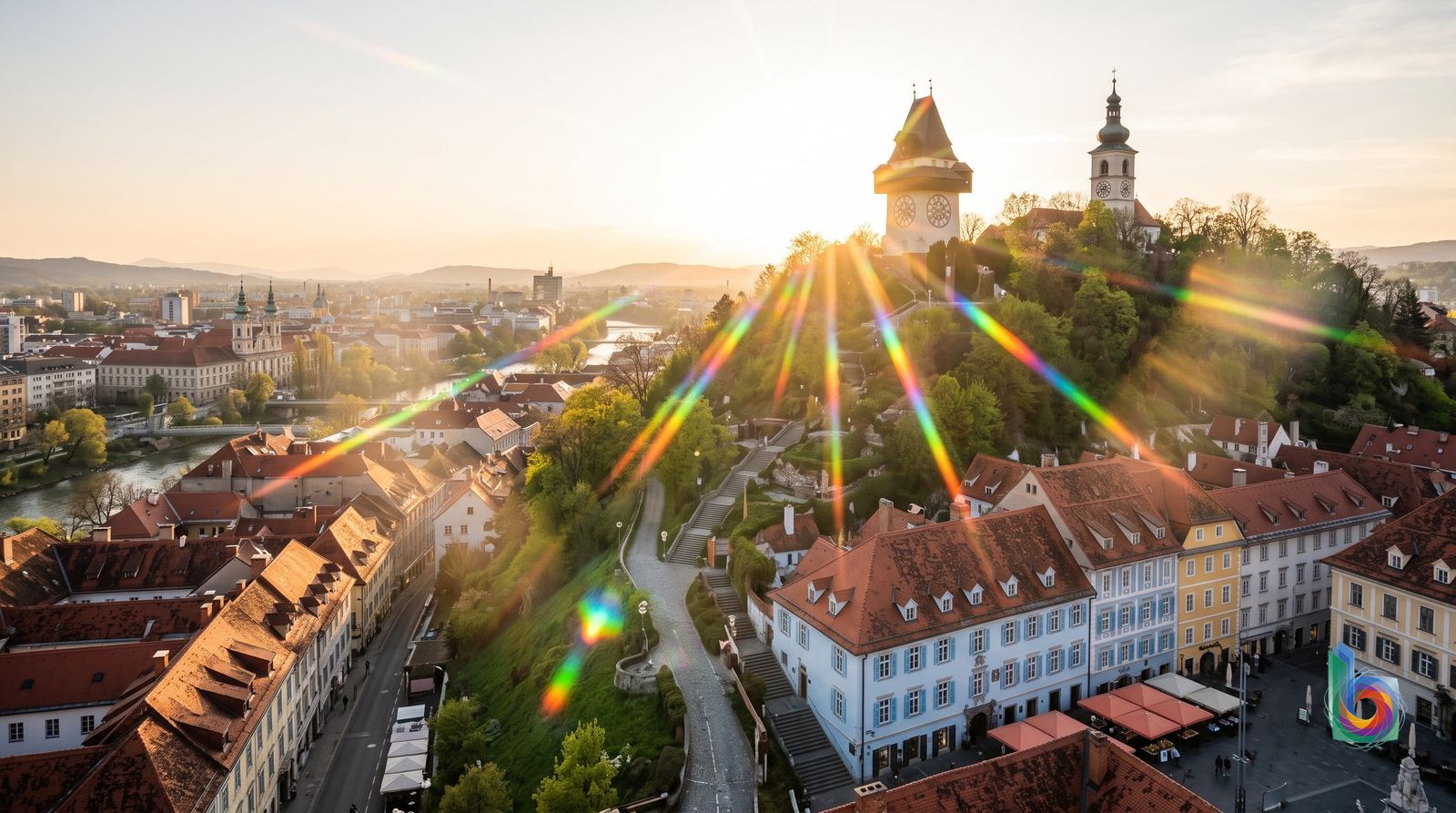
January–March
Cold, often grey and with short daylight; Graz is quieter and better for cafés, the Armoury and other indoor stops than for a first-time walking-heavy visit. Schloss Eggenberg’s palace interiors are closed roughly from 1 January to late March.
This is the weakest period for Schlossberg views and long outdoor days, and Eggenberg should not be the anchor of the itinerary.
April
Spring begins to make walking pleasant, though temperatures and rain can still be changeable.
Weather is less dependable than in May or June; pack for rain and cool evenings.
May–June
The prime window: generally mild weather, long days and comfortable conditions for the old town, Schlossberg and riverside walking without the usual high-summer heat.
Styriarte and other summer programming can tighten central hotel, restaurant and performance availability, especially on weekends.
July–August
Sunny, long days and potentially hot afternoons. The compact centre remains easy to navigate, but the hill climb and exposed streets are better early or late in the day.
Heat is the practical drawback; use museums, shaded courtyards and lunch breaks at midday. Festival dates can make central accommodation and popular restaurants noticeably tighter.
September–15 October
A second excellent shoulder season, usually mild enough for long walks with a calmer feel than summer and the first signs of autumn.
Major autumn cultural programming can raise demand for central rooms and performance tickets; weather becomes more variable as October progresses.
16 October–November
Cooler, darker and often wetter, but generally quiet enough for an unhurried city break built around interiors, cafés and restaurants.
Shorter days reduce the appeal of a sightseeing plan centred on Schlossberg and outdoor neighbourhood wandering.
Styriarte · Usually June and July
Graz’s major classical-music festival is one of the city’s clearest reasons to book performances as soon as dates are announced. It can also tighten central hotels and dinner reservations around sought-after concerts.
La Strada International Street Theatre Festival · Usually late July or early August
Free outdoor theatre and circus performances bring crowds into central public spaces. Expect busier streets around programmed venues and reserve accommodation early if your dates overlap.
steirischer herbst · Usually late September to mid-October
This major contemporary-arts festival brings performances, installations and events across Graz. Specific shows can sell out, while central accommodation is more in demand than on an ordinary autumn weekend.
Graz Advent and Christmas markets · Usually late November through 23–24 December
The old town is at its most atmospheric but also at its busiest in the run-up to Christmas. Weekend central hotels and restaurants merit advance booking; expect crowds around Hauptplatz and the main market areas.
Walking
The Altstadt, Lend by the river, and the lower Schlossberg: Hauptplatz, Herrengasse, Landhaus, Kunsthaus and Murinsel are the kind of compact Graz sights best joined on foot. It is also the right way to absorb the city rather than treating it as a tram-map exercise.
Use Hauptplatz as the central reference point; Jakominiplatz is about 10 minutes south-east on foot, and Hauptbahnhof is around 20 minutes west via Annenstraße. For Schlossberg, take the gentler eastern approach from Karmeliterplatz or the 260 steps from Schlossbergplatz.
Walking stops being efficient on the Schlossberg itself, particularly in rain or ice, and for Eggenberg, Mariatrost, Messe/St. Peter and much of northern Geidorf. Gries and Annenstraße are practical walking territory but not the city’s most pleasant stroll after dark.
Tram and bus
The default for trips beyond the core: tram for Hauptbahnhof, Eggenberg, St. Leonhard, Geidorf, Messe/St. Peter and Mariatrost; buses for network gaps and cross-city errands. Jakominiplatz is the essential interchange, with trams radiating through it.
Buy a Zone 101 ticket: about €3.30 for one hour or €7.20 for 24 hours, covering city trams, buses and the airport. Tickets bought on a tram are already validated; tickets bought at kiosks or before boarding a bus must be stamped. Use the small free-tram zone around Hauptplatz/Jakominiplatz only for a short central hop, not as a day-pass substitute.
The network is strongest by day and around Jakominiplatz, not for late spontaneous returns. Service thins after midnight; night buses are chiefly for Friday, Saturday and nights before public holidays. Mariatrost is straightforward on Tram 1 but feels genuinely suburban after an evening out, while Eggenberg and Messe/St. Peter require committing to a tram ride rather than walking home from the old town.
Cycling
Longer, mostly level central rides—especially between Geidorf, St. Leonhard, Lend, Gries and the river corridors. Graz’s cycle paths make a bike more appealing than a car for travelers staying outside the postcard core or spending several days in town.
Choose cycling when your hotel is in Geidorf or the university side and you want to avoid repeated 20-minute walks to Hauptplatz. It is also a good way to connect Lend and the central districts without waiting for a tram.
It is not a shortcut up Schlossberg, and it is less compelling for a first-time, sight-packed weekend when the Altstadt is already walkable. Tram tracks, busy junctions around Jakominiplatz and traffic-heavy stretches of Gries/Annenstraße require attention.
Schlossberg funicular or lift
Saving your legs for the Clock Tower and hilltop views, particularly if you are coming from the old town in hot weather or cannot manage the steep paths and steps.
Treat it as a hill-access tool, not a replacement for exploring: walk up if able, then use the funicular or lift when energy, weather or mobility makes the climb unattractive. The lower access points are only a few minutes from Hauptplatz.
It solves the hill, not the wider city’s transport needs. The Schlossberg thins out after sightseeing hours, and the surrounding slope streets are a poor luggage base; stay in Altstadt or another transit-served district instead.
Taxi
Late-night returns when normal service has thinned, luggage to or from a hotel, and the occasional trip where a direct ride is worth more than waiting—especially from more peripheral addresses in Mariatrost or Messe/St. Peter.
Use taxis selectively rather than as everyday sightseeing transport. They are more useful after midnight than trying to force a complicated tram-and-walk return, particularly outside the Friday/Saturday/pre-holiday night-bus pattern.
They are unnecessary for most central journeys and poor value from the airport: the S5 from Flughafen Graz-Feldkirchen to Hauptbahnhof is roughly 15 minutes within Zone 101, versus a far more expensive taxi. Graz is compact enough that taxis should be the exception, not the plan.
Car
Leaving Graz for Styrian countryside destinations, not for moving between city sights.
If you arrive with a car, park it and switch to walking and transit for the centre. Build city days around the Altstadt, Jakominiplatz and the tram network instead of driving between attractions.
Do not rent a car solely for Graz. Parking, one-way streets and historic-core access make it more trouble than it is worth; it is especially pointless in Altstadt, Lend, Gries and Jakomini, where the main visitor areas are walkable or directly transit-served.
Safety: Graz is broadly safe and easy to walk at night; use normal city precautions, keep valuables close on late trams and in crowds, and treat Jakominiplatz and the Hauptbahnhof area as transport hubs rather than lingering spots.
Book before you land
SchöcklHalf day to a full day (allow roughly 40 minutes each way by bus to the cable-car base, plus the mountain).
This is the one easy escape that gives Graz what it lacks: real mountain scale. Take bus 250 from Jakominiplatz or Andreas-Hofer-Platz to the St. Radegund cable-car base, then ride or hike up for broad views and proper walking. It beats a second museum-heavy Graz day if the weather is clear; it does not beat the city in cloud, wind or rain.
Austrian Open-Air Museum, StübingHalf day, or a relaxed full day if you walk the whole site.
A genuinely strong rural-Austria complement to Graz’s Habsburg cityscape: historic farm buildings from across Austria set through woodland, rather than a token heritage display. Go if you want context for Styria beyond the old town. It is seasonal—generally April to October—and closed Mondays except public holidays.
RiegersburgFull day door-to-door.
A fortress on a volcanic crag is a more dramatic proposition than another lap of Graz’s compact centre. Its Ottoman-siege history and looming setting make it the best castle excursion from the city; the downside is that it is an excursion, not a quick add-on, and weather matters on the exposed hill.
Semmering Railway and the Semmering passFull day if you get off to explore the Semmering area; a scenic long half-day if you simply ride a section and return.
Take the train north for the journey itself: the UNESCO-listed Semmering Railway is one of Central Europe’s great rail landscapes, threading mountains, viaducts and tunnels. This is better than another city day for rail and Alpine scenery enthusiasts, but less so for anyone who wants a destination with concentrated sights. Graz–Vienna trains traverse the route; sit on the right heading from Graz toward Vienna for the best-facing views.
Loipersdorf Thermal SpaFull day door-to-door.
Choose this over another day in Graz only when the point is recovery, not sightseeing. A thermal-spa day is an especially good cold- or wet-weather reset after hiking or a fast-paced Austria itinerary; it is not a cultural substitute for Graz’s museums and old town.
Researched Nov 11, 2026