December–April
Nassau’s driest and most comfortable period: warm rather than punishingly hot, with comparatively lower rainfall. It is also the expensive high season, and downtown can feel distinctly unpleasant when cruise ships are in port.
Higher hotel and excursion demand, with limited-capacity boat trips and Blue Lagoon programs worth reserving weeks ahead. Cruise-day crowds and sales pressure are strongest around Bay Street and the port.
May
A useful shoulder month: still warm, with a growing chance of showers but generally workable beach weather.
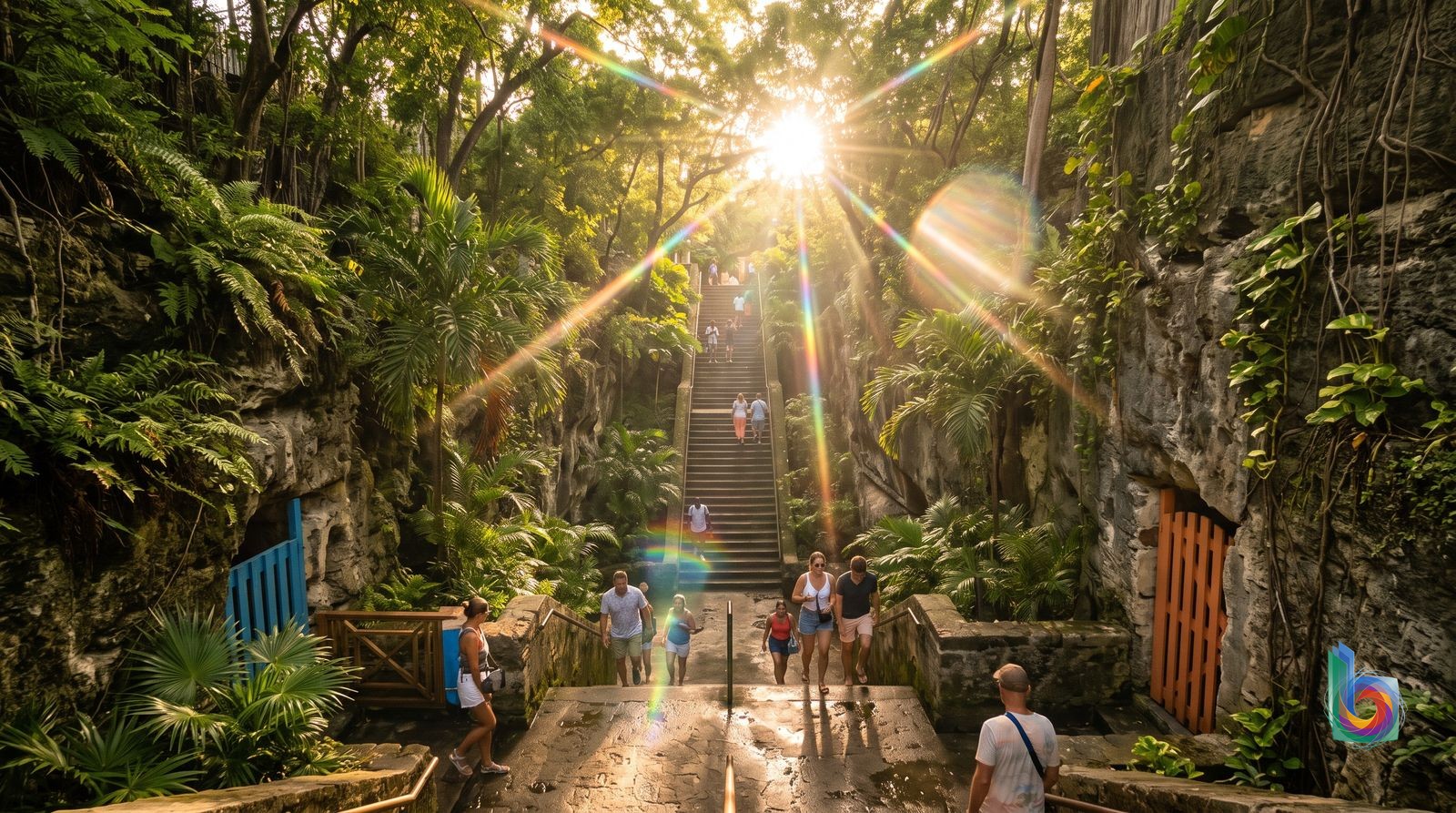
Rain is more likely than in winter, and the heat begins to build. Schedule exposed walks such as the Queen’s Staircase and Fort Fincastle early.
June–October
The hottest, wettest stretch and the core of hurricane season. Rain often arrives as intense bursts rather than an all-day washout, but tropical-weather disruption is the serious planning risk.
Humidity, heavier rain and possible storm disruption. Do not build a tightly timed itinerary around a single boat excursion or transfer day; keep plans flexible and monitor weather.
November
Another practical shoulder month, generally easing away from the wettest summer pattern while remaining warm.
Showers remain possible, and conditions are less reliably dry than December–April. Demand starts to rise as winter approaches.
Walking
Downtown Nassau & Bay Street, including the cruise port, Parliament Square, the Queen’s Staircase and Fort Fincastle; Arawak Cay and Junkanoo Beach are a feasible westward extension.
Treat central sightseeing as a sweaty half-day on foot: start early, carry water and combine two or three sights rather than trying to cover the whole island. Use taxis for the gaps between districts.
Walking stops being pleasant beyond the compact center. The climb toward Fort Fincastle and Over-the-Hill is hot and uphill; Cable Beach, Paradise Island, Montagu and the west side are not practical casual walks. Do not wander unfamiliar Over-the-Hill streets after dark or use isolated beaches at night.
Jitney minibuses
Cheap daytime travel from downtown to Cable Beach on the #10/#10A, plus daytime links along Bay Street toward eastern districts.
Flag down the shared minibuses along Bay Street and nearby streets; carry exact cash and ask the driver if the route serves your specific stop. The #10/#10A are the useful downtown–Cable Beach link.
This is informal transport, not a timetable-led network: vehicles can wait to fill, route information is inconsistent and service mostly ends around 6–7pm, with limited Sunday service. There is no jitney to Paradise Island. Coverage is increasingly inconvenient west of Cable Beach—Sandyport, Old Fort Bay and Love Beach—and fragmented in Eastern New Providence and Yamacraw.
Licensed taxi
Airport arrivals, luggage, nighttime travel, Paradise Island, resort-to-resort trips and any stay in Love Beach, Sandyport, Old Fort Bay, Eastern New Providence or Yamacraw.
Use licensed taxis with yellow licence plates. Agree the total fare before getting in, including whether it is per car or per person and any luggage charge; meters may not be used. Arrange a return taxi when heading somewhere remote.
Costs mount quickly, especially from far-west Love Beach or Sandyport and from the eastern residential districts. Do not accept rides from strangers, excursion touts or self-described taxi drivers; ride-hailing is not a dependable backup.
Downtown water taxi
A pleasant daytime crossing between downtown Nassau’s harbor and Paradise Island when you are not carrying much luggage or rushing.
Board from the downtown harbor and use it as a daytime alternative to a short taxi ride across to Paradise Island.
It is not a late-night solution: service stops around 6pm. It also does nothing for Cable Beach, the airport, Sandyport, Love Beach or the eastern end of New Providence.
Rental car
Deliberate island exploring and stays in car-dependent districts: West Bay Street, Sandyport, Old Fort Bay, Love Beach, Eastern New Providence and Yamacraw.
Rent only if you will genuinely explore beyond the resort corridors or need daily independence from taxis. Remember that traffic drives on the left.
Road conditions and driving standards are uneven, and downtown parking is more trouble than it is worth. A car is unnecessary for a Downtown, Cable Beach or Paradise Island stay focused on beaches and central sights.
Safety: Keep phones and jewelry low-key, avoid Over-the-Hill, isolated streets and beaches after dark, and use a licensed yellow-plate taxi—agreeing the full fare before departure—rather than walking or accepting unsolicited rides.
Book before you land
Exuma Cays by day tour or small-plane excursionFull day — realistically 9–11 hours door to door, longer if the itinerary uses a flight and airport transfers.
This is the one true splurge day from Nassau: absurdly clear water, cays, snorkeling and the swimming-pig circuit deliver the Out Islands scenery that New Providence does not. It beats another resort-and-cruise-ship day in Nassau if you have at least three nights. The downside is equally real: it is expensive, tightly scheduled and often built around photogenic animal stops rather than quiet island time.
Rose Island by boatMost of a day — typically 6–8 hours door to door including getting to the departure marina.
A low-key beach-and-snorkel escape close to Nassau, with water and reef time that are more compelling than downtown souvenir shopping. Choose a small-group operator if possible; big catamaran and party-boat versions can turn it into the same crowd scene you were escaping.
Blue Lagoon IslandHalf to full day — allow 5–7 hours door to door, depending on the ferry schedule and package.
Worth it primarily for a contained, easy beach-and-water day, especially for families or first-time visitors who do not want a long boat run. It beats a second day in central Nassau, but it is a managed excursion island, not an unspoiled Out Island experience; cruise-ship crowds can flatten the appeal.
Researched Nov 9, 2026