
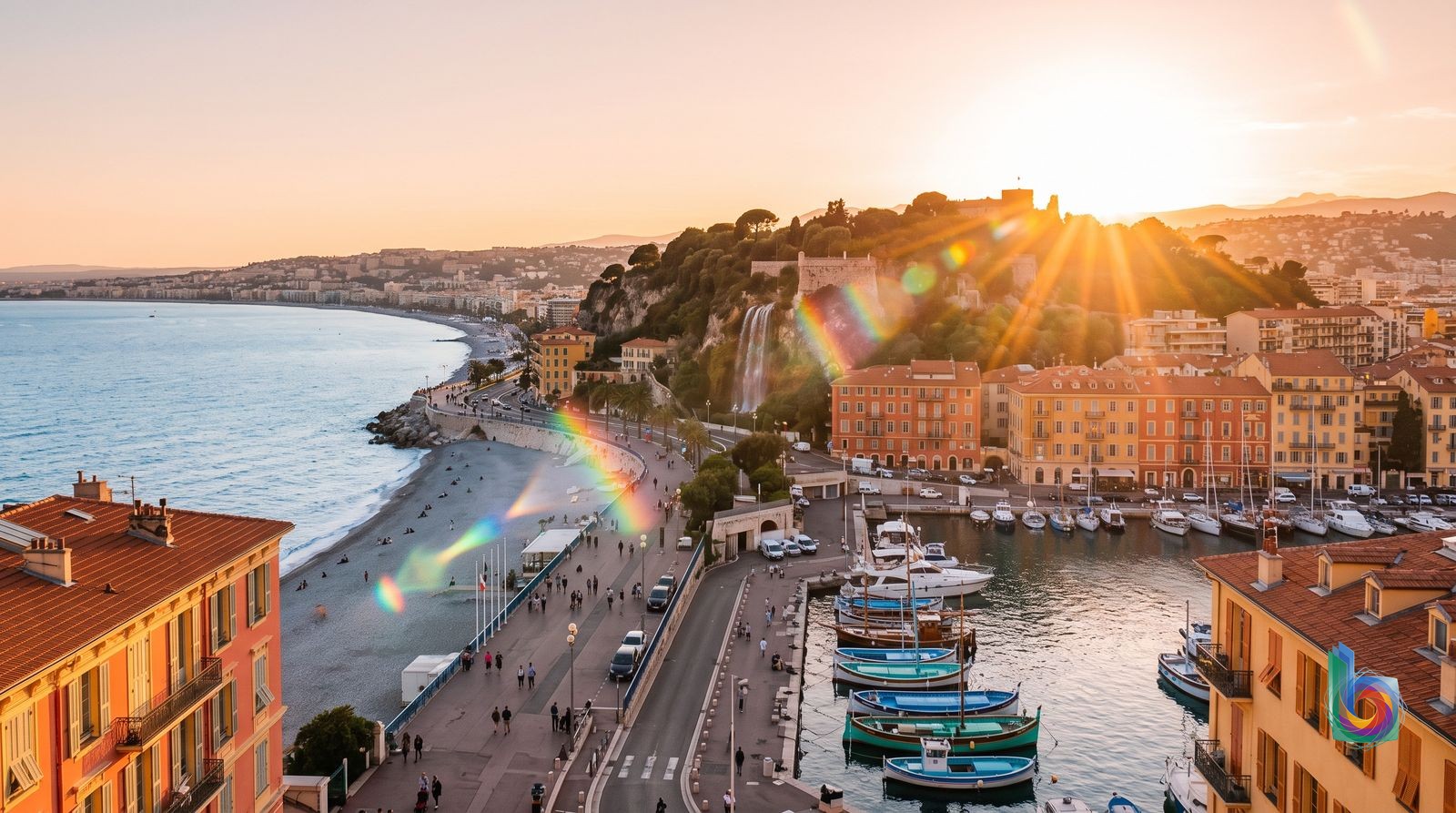
Season by season
January–March
Winter is mild and can be sunny, but it is not dependable beach weather. Museum hours may be shorter, and many museums close one day each week.
Cooler weather and limited swimming; February is an exception to the quiet-season feel because Carnaval fills the centre and disrupts access.
April–June
The best spring-to-early-summer window for walking, sightseeing and occasional sea days. Nice warms gradually, so April can still feel surprisingly cool; conditions are generally more comfortable than midsummer.
The Cannes Film Festival, usually in May, can push up Riviera hotel prices and make transport busier even though Cannes is outside Nice.
July–August
Hot, busy peak season, with the beach, Promenade and Old Town at their most crowded. Sea weather is at its most reliable.
Higher prices, intense crowds and heat. Coastal roads and buses can be slow; use TER trains for Riviera day trips when time matters.
September–October
The other top window: generally pleasant walking weather, workable sea days and less punishing crowd levels than July and August.
Sea conditions and beach weather become less reliable as October progresses, and the city is no longer in full summer mode.
November–December
A mild, often sunny low season rather than beach season. It suits an urban break more than a resort holiday.
Cooler, less reliable weather for the sea; some museums operate shorter schedules and may have a weekly closing day.
Events worth planning around
Nice Carnaval · Usually February; exact dates vary each year.
A major event that transforms central Nice with parades and road closures. Expect higher accommodation demand and a busier centre; reserve well ahead if travelling during the main parade period.
Cannes Film Festival · Usually May; exact dates vary each year.
It is in Cannes, not Nice, but it can inflate room rates across the Riviera and make regional transport and accommodation harder to secure. Book Nice lodging and TER-dependent plans earlier than usual.
Getting around
Walking
Vieux Nice, Place Masséna, Centre Ville / Carré d’Or, Jean Médecin, Garibaldi/Port Lympia and the central Promenade des Anglais. For most short stays, walking is the best way to join up the beach, Old Town, shopping streets and dinner.
Treat Nice as three bands: the seafront, the dense centre and Old Town just behind it, then the hills. Wear shoes that handle cobbles and the Promenade’s distances; a walk along the waterfront is pleasant but longer than it looks on a map.
Walking stops being effortless in Cimiez and Mont Boron: the climbs are substantial, especially in heat or with luggage. It also becomes a poor plan from western Fabron/Magnan to Old Town, and from Nice-Ville to Vieux Nice with heavy bags. Around Nice-Ville/Thiers and crowded tram stops, keep valuables zipped away.
Tram
The reliable default for crossing central Nice and reaching the airport. Tram 1 is the north–south spine for Libération, Nice-Ville/Jean Médecin, Place Masséna’s vicinity, Vieux Nice’s western edge and Garibaldi. Tram 2 is the east–west airport/centre route and reaches the Port area.
Buy and validate before boarding, and check the current Lignes d’Azur fare rather than relying on old guidebook prices. From the airport, Tram 2 is free between Terminal 2, Terminal 1 and Grand Arénas; change or begin a normal city fare at Grand Arénas for the onward ride toward the centre. Jean Médecin is the key Tram 1–Tram 2 interchange.
The tram does not solve the hills: Cimiez depends mainly on buses, and Mont Boron is not a simple tram ride. It also runs inland, not along the Promenade, so western Promenade/Gambetta and Fabron/Magnan addresses usually require a walk or bus. Late at night, check last services rather than assuming a tram home.
Bus
Cimiez, the western Promenade/Fabron/Magnan stretch, and addresses away from the tram lines. It is the practical fill-in network when the destination is uphill or along the seafront rather than at a tram stop.
Use the Lignes d’Azur journey planner or live information on the day; allow extra time and validate as required. From Cimiez, take a bus down to the centre rather than planning to walk both ways. For a beach-oriented stay in Magnan or Fabron, buses connect the seafront and residential streets to central Nice.
Buses are the least dependable option when Riviera roads clog, particularly in peak season. Cimiez can leave you bus- or taxi-dependent after dinner, while Fabron/Magnan feels disconnected from Old Town at night. For time-sensitive coastal trips, do not choose a packed road bus over the TER.
TER regional train
Day trips and airport-side rail connections: Monaco, Menton, Villefranche-sur-Mer, Antibes and Cannes. It is generally the quickest, least stressful way to move along the Riviera when roads are busy.
Use Nice-Ville as the main hub for most coastal trips. Nice-Saint-Augustin, beside Grand Arénas and Tram 2, is useful for changing between the airport and trains toward Monaco/Menton or Cannes/Antibes; it is not a replacement for Nice-Ville when staying centrally. Check the day’s timetable and platform before travel.
TER solves the coast, not local Nice. Nice-Ville is inconvenient from Port Lympia, Riquier’s eastern side, Cimiez and the far-western Fabron/Magnan area without a tram, bus or taxi connection. Trains can be busy in summer, so leave margin for popular beach-day routes.
Taxi or rideshare
Late-night returns, luggage, steep hills and door-to-door trips where a bus connection is awkward—especially Cimiez, Mont Boron and far-western addresses. It is also sensible after an evening in Vieux Nice when you do not want to negotiate hills or reduced service.
Use licensed taxis or a booked app ride such as Uber or Bolt. At Nice Côte d’Azur Airport, follow signs to the designated rideshare pickup zone; do not accept approaches from unsolicited drivers. A taxi is a convenience purchase, not the standard way to see central Nice.
Cars are slow and comparatively expensive in the dense centre, and cannot reach every Vieux Nice door. Traffic can make a short ride along the Promenade or coast unexpectedly long; use the tram or walk for central journeys and the TER for Riviera day trips.
Rental car
Only for an itinerary that leaves Nice for poorly connected inland Provence, with accommodation that has confirmed parking. It is not useful for a city-based Nice break.
If a car is genuinely necessary, collect it only when departing the city and return it before spending time in central Nice. Confirm parking arrangements with every hotel rather than assuming street parking will work.
Avoid renting one for Nice itself: parking, one-way streets and Riviera traffic erase the benefit. It is particularly counterproductive in Vieux Nice, Centre Ville, the Promenade corridor and around Nice-Ville; use walking, trams and trains instead.
Safety: Keep valuables in a zipped bag on trams, in Old Town crowds and around Nice-Ville, and avoid the rougher streets just south of the station or the far-eastern Arianne/Pasteur areas late at night.
- Nice is not a sandy-beach resort. The public beaches are large pebbles, the sea shelves steeply and currents can be strong: bring water shoes, and do not assume it is ideal for small children or weak swimmers.
- Keep phone and wallet secure in crowds, on trams and around Nice-Ville/Thiers station. Pickpocketing is a persistent Riviera problem; use an inside pocket or zipped bag rather than a loose back pocket.
- Validate every transit ticket/card when boarding. The airport trick matters: Tram 2’s terminal-to-Grand-Arénas segment is free, so a normal city ticket from Grand Arénas is often better value than the airport-specific fare.
- Make a little effort in French. Nice has a distinct Nissart/Italianate history and bilingual street signs, but French—not Nissart—is the language you should expect to use; English is not universal away from tourist businesses.
- The Promenade’s heavy police and military presence is normal in post-2016 Nice. Treat it as routine security, but avoid wandering late at night in the far-eastern Arianne/Pasteur areas or the rougher streets immediately south of Nice-Ville.
- Restaurant service is included in the bill; round up or leave a small extra only for good service. Carry a contactless card, but keep a little cash for small purchases and markets.
Worth leaving the city for
Villefranche-sur-MerHalf day — about 20–30 minutes each way by TER or bus, plus beach time.
Take this over another Nice beach day if you want an actual swim: the small bay is calmer and less punishingly pebbly than Nice, and the old harbour is compact enough to pair with a coastal walk. It is much quieter than Nice, though it fills quickly in summer.
Èze VillageHalf day — roughly 45–60 minutes each way by bus; allow longer if hiking down to the coast.
The medieval village clinging to its ridge and the Mediterranean panorama are unlike anything in central Nice. Go for the view and the lanes, not the perfume-factory sales pitch. Use a bus to Èze Village; Èze-sur-Mer/Èze Gare is far below the village and means a steep walk unless you deliberately want the Nietzsche Path.
Saint-Jean-Cap-Ferrat and Villa Ephrussi de RothschildHalf to full day — about 40 minutes each way on bus 15, plus walking around the cape.
This is the Riviera at its most absurdly beautiful: a proper coastal path, swim stops and the Ephrussi villa and gardens amid billionaire real estate. It beats another museum day in Nice when weather is good. The downside is that it is expensive if you enter the villa and the cape is not a quick in-and-out stop.
MentonFull day — around 45–60 minutes each way by TER from Nice-Ville, plus local walking.
Menton has warmer-looking Italianate colour, a real old town and a more relaxed edge-of-France character than Nice; it feels like a destination rather than an extension of the city. Go by TER, not a slow crowded coast bus. It is a long way for a short visit, so give it a full day.
Monaco and Monte-CarloHalf to full day — about 25–30 minutes each way by TER.
Monaco is worth one deliberate visit for the extreme density of money, the harbour, the old rock and the sheer unreality of it—not because it is charming in the way Nice is. It is efficient by train and easy to leave once the spectacle wears thin; skip it if casinos, luxury cars and cruise-day crowds repel you.
Entrevaux on the Train des PignesFull day — roughly 2 hours each way from Nice on the Train des Pignes, plus the climb to the citadel.
For a complete change of scene, take the narrow-gauge Train des Pignes into the mountains to Entrevaux: fortified village, castle above it and actual Alpine-Provençal air. This is a better use of a spare day than another Riviera resort if you want landscape and history. Timetables are the constraint, so check them before committing.
Researched Nov 7, 2026
