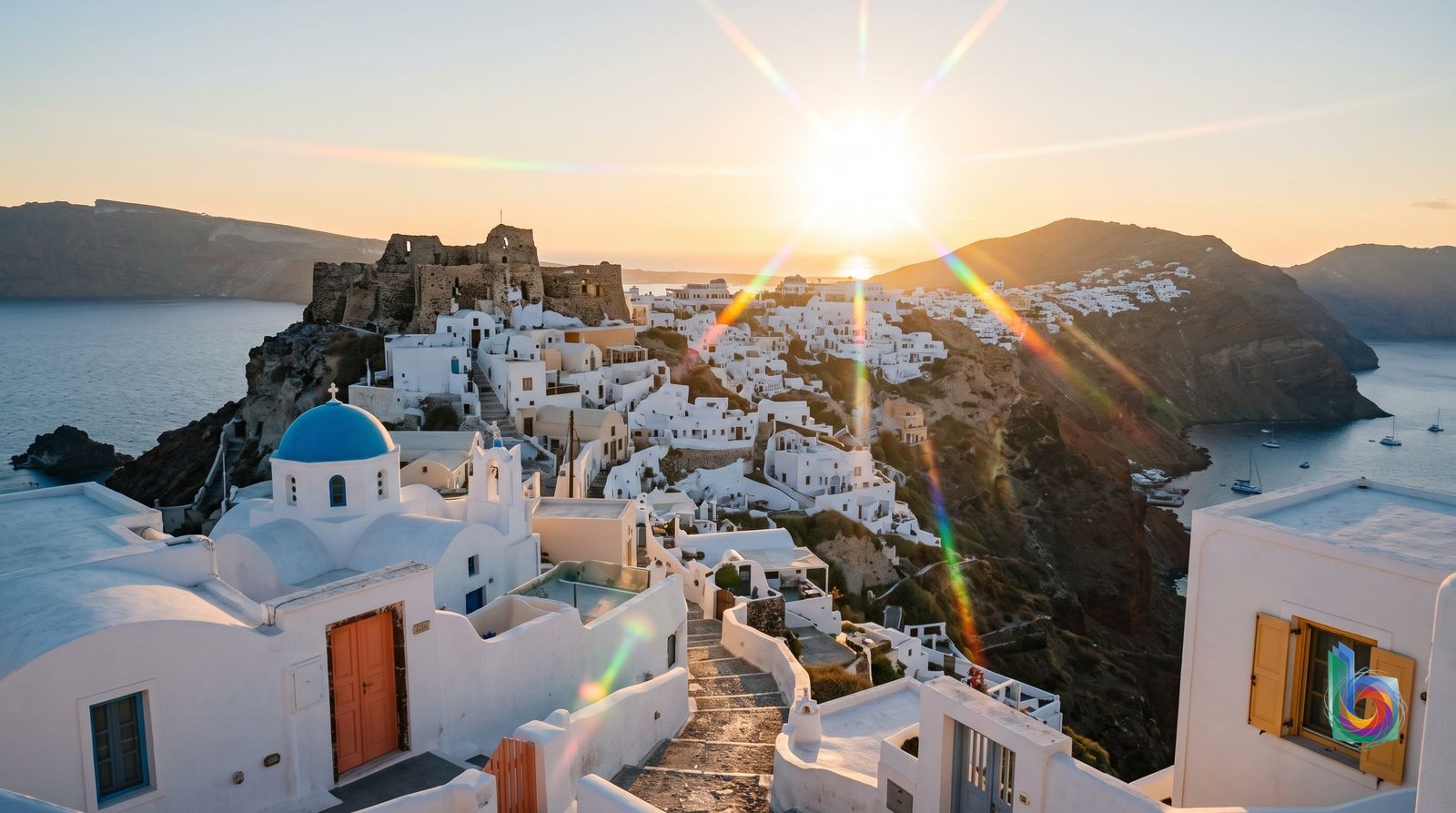
Season by season
November–March
Quietest part of the year, with a much less crowded village but reduced tourism infrastructure.
Many hotels, restaurants and seasonal businesses close, so this is not automatically an easy bargain or the simplest first-time visit.
April–May
The most balanced spring window: the main tourist season is operating and walking conditions are generally kinder than high summer.
Oia is still a major day-trip destination; arrive early or stay locally for its quieter hours, and sunset viewpoints remain busy.
June–August
High summer brings hard sun, the highest prices and heavy cruise-ship/day-trip traffic. July and August are the most overwhelmed months, especially from late morning through sunset.
Expect heat, packed pedestrian lanes, scarce taxis, crowded buses and a serious sunset crush. Reserve non-negotiable caldera sunset sails and caldera-terrace dinners ahead, particularly June–September.
September–October
The strongest autumn alternative to summer: services remain open, temperatures are more walking-friendly, and pressure is marginally lower than the peak.
It is still within the main April–October tourist season, not a secret shoulder-season escape. Day visitors and sunset crowds remain a daily reality.
Getting around
Walking
Central Oia, Kastro and the caldera lanes; also the walk between central Oia and Perivolas, if you are comfortable with slopes and steps. Oia is compact enough to cross in roughly 20–30 minutes, but that is not the same as an easy walk.
Treat the historic center as pedestrian-only. Wear shoes with grip, carry water, and leave extra time for stairs, heat and photo traffic. Walk down to Amoudi or Armeni only if you are prepared for the climb back up.
Walking stops working well for luggage, limited mobility and midday heat. Kastro has uneven paving and steps; Amoudi Bay and especially Armeni Bay are connected to Oia by steep stair routes, not an effortless harbor stroll. Finikia is walkable from Oia but the return is unappealing in heat or after dinner.
KTEL bus
The inexpensive link between Oia Bus Station and Fira, Santorini’s transport hub. Use it for reaching the rest of the island via Fira rather than expecting a dense local Oia network.
Buses run between Oia and Fira about hourly. Bring cash and small change; the service is described as cash-only. For airport or ferry-port trips, change in Fira and allow plenty of connection time.
The bus gets you to Oia, not to every part of the Oia area. It is a poor solution for Baxedes and Paradisos, Koloumbos, Amoudi Bay and Armeni Bay, where onward walking, a taxi or a hotel transfer is needed. Late-night flexibility is limited, so do not plan a late dinner or sunset departure around an assumed last bus.
Taxi or pre-booked transfer
Airport and ferry arrivals with bags, trips after dark, and stays outside the pedestrian core—particularly Baxedes and Paradisos, Koloumbos, and cliffside hotels that can arrange the closest practical drop-off.
Pre-book longer rides and ask your hotel exactly where vehicles can meet you and how bags will be handled. A direct airport-to-Oia transfer normally takes about 30–40 minutes in normal traffic; allow longer from Athinios ferry port because traffic and the winding road via Fira can slow things down.
Taxis are limited and difficult to summon around sunset and after ferry arrivals; do not assume an app car will appear. They cannot deliver you door-to-door in Central Oia or Kastro, where vehicles are banned from the lanes and the final approach may involve stairs.
Rental car
Baxedes and Paradisos, Koloumbos, and independent exploration of the wider island. It is most useful when your accommodation has road access and you value leaving Oia on your own schedule.
Use a car to reach the Oia area, then park where your accommodation or public access permits and continue on foot. It makes the open-coast districts substantially more practical than relying on buses or taxis.
A car is more burden than benefit in Central Oia and Kastro: the core is pedestrian, parking is not doorstep access, and narrow roads are stressful in peak season. It also does not solve the stair-only access to Amoudi Bay or Armeni Bay.
Boat
A day trip to Therasia, the quieter island across the caldera. Once there, explore Riva harbor and Manolas on foot.
Check current local boat operations before committing to the trip; treat schedules as an excursion service, not a guaranteed commuter link. Build in margin if you have a dinner booking, ferry connection or flight afterward.
Boat-dependent transport is a bad backbone for a short stay or an early departure. A missed or cancelled crossing has much bigger consequences than a missed Oia–Fira bus, and the climb between Riva and Manolas is not suitable for every traveler.
Bookable experiences per person, per day
- Value
- $97
- Typical
- $194
- High
- $320
Based on 1575 currently available tours and tickets. Hotels, meals and transport are not included.
Safety: Wear grippy shoes and carry water for Oia’s steep, polished lanes; at sunset keep valuables zipped and avoid stopping in bottlenecks or climbing private walls and roofs for photos.
Book before you land
- Carry cash and coins for KTEL buses; the Oia–Fira service is described as cash-only. Do not assume cards or a ticket app will solve a bus journey.
- Wear shoes with grip, not beach sandals, for polished stone, steep stairs and the descent to Amoudi or Armeni. Take water and sun protection; shade is scarce on the caldera edge.
- The sunset crush is real. Do not stop dead in narrow lanes for a photo, block doorways, or treat private hotel terraces and steps as public viewing platforms.
- Pickpocket risk rises in the packed lanes during the tourist season. Keep phone, wallet and camera secured; a hip pouch is not a serious defense, and do not leave electronics unattended.
- Oia is a tiny working settlement wrapped in a tourism machine, not an open-air resort. Keep voices down late at night, respect church interiors, and do not climb walls or roofs for the ‘better’ photo.
- For swimming, choose the less-developed Armeni Bay or Katharos if you want fewer people; Amoudi is scenic but becomes very busy around sunset.
Worth leaving the city for
TherasiaHalf day; allow 4–6 hours door to door, including waiting for the seasonal boat schedule.
The one genuinely useful escape from Oia’s staged, crowded caldera theatre. This quieter inhabited island is part of Oia’s municipal unit but feels like a different Santorini: fewer boutiques, broader views back to the cliff towns, and a reason to slow down rather than queue for a sunset photo. Ferries from Oia make the crossing in about 20 minutes.
Akrotiri archaeological site and the south coastFull day; realistically 7–9 hours from Oia with road transfers and the site.
Choose this over a second day of Oia lanes if you want substance: Akrotiri is Santorini’s major Bronze Age settlement, dramatically unlike the rebuilt, tourism-led village at Oia. Pair it with the volcanic south coast rather than treating it as a rushed photo stop. From Oia, getting there normally means routing via Fira or taking a car/taxi, so it is not a casual hop.
Nea Kameni caldera boat tripMost of a day; allow 6–8 hours from Oia once transfers to the departure port and boat time are included.
Worth doing once for the thing Oia’s views are actually looking at: the active volcanic landscape in the middle of the caldera. It is more memorable than another round of shops and sunset crowds, but choose a boat trip for the volcanic setting, not for promises of a luxurious hot-spring swim or serene sailing—these trips can be busy and weather-dependent.