- Pace
- Stay in one hotel: Budapest is a 3–4-night first visit at minimum, and five nights is the sweet spot for the classics plus one outer-city excursion without rushing. The central core is usually 20–35 minutes apart by foot or transit, but Aquincum, the Buda Hills and Memento Park each take roughly 45–75 minutes each way from central Pest; treat them as half- or full-day commitments, not add-ons between central sights. Two nights is only a sampler, while 6–7 nights supports deeper museums, food, concerts and the city’s edges.
- When to go
- For most first visits, go in April–May or September–October: you get workable walking weather, baths that feel like a pleasure rather than an escape, and fewer crowds than peak summer. September is the strongest single month; July–August bring long evenings but real heat in Pest, while winter is best for low hotel rates, cafés, museums and thermal baths. Avoid assuming spring is reliably mild—March can be raw—and book early for Advent weekends and the mid-August Sziget festival.
- Daily budget
- 65,000–110,000 HUF
Budapest is not a cluster of day-trip towns but one oversized, intensely layered capital: imperial Danube scenery, grand Pest boulevards, historic Buda hills, Communist-era memory, serious café-and-pastry culture, nightlife and genuinely central thermal-bath culture. It works best as a city break with enough depth to reward slowing down—less about ticking off monuments than moving between riverfront grandeur, lived-in neighborhoods, baths, museums and late-night food.
Known for
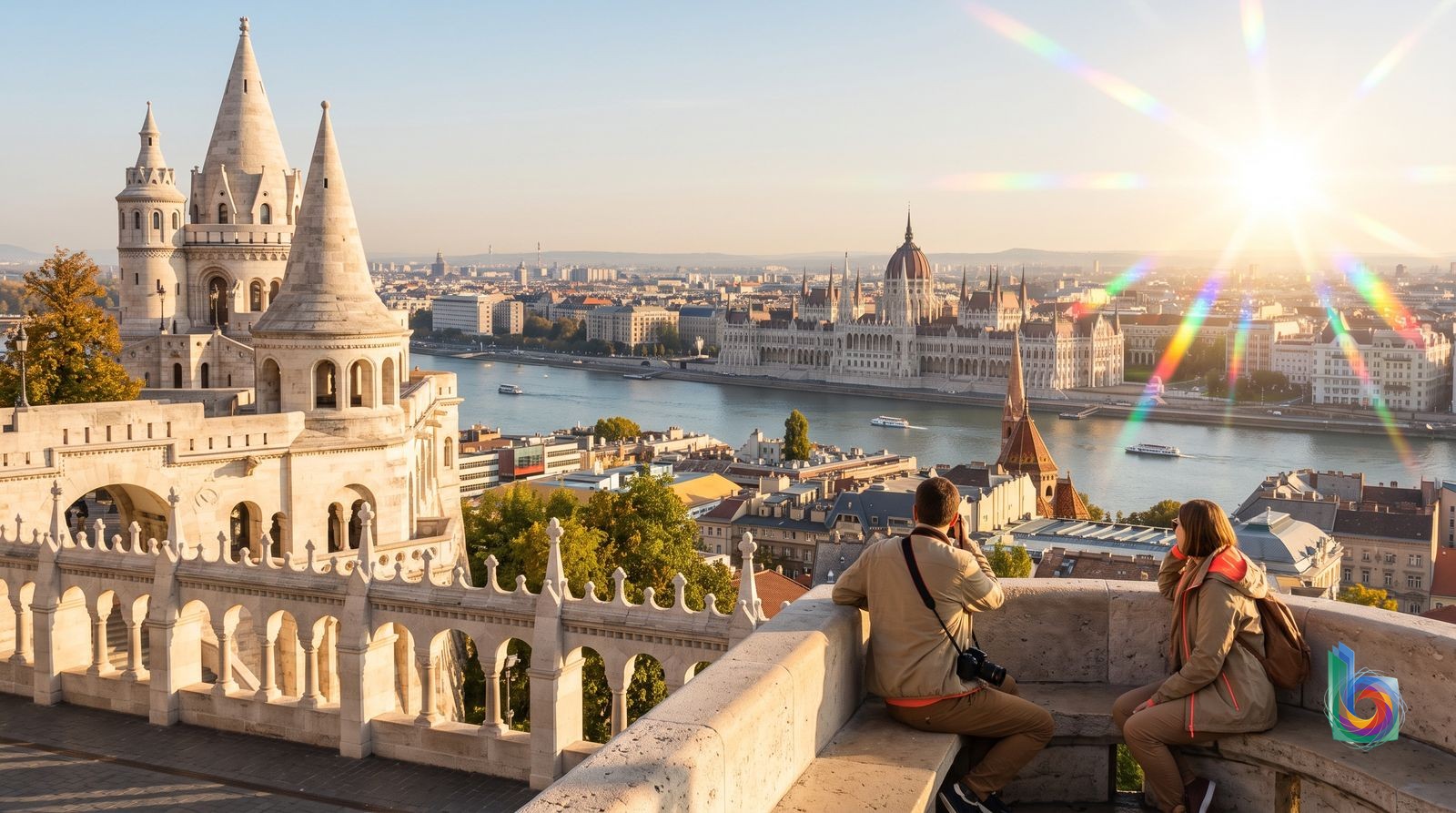
- The Danube panorama, Parliament and the UNESCO-listed riverbanks
- Buda Castle Quarter, Castle Hill and Parliament-facing views
- Thermal baths, from Ottoman-era Rudas to theatrical Széchenyi
- Grand 19th-century architecture, Andrássy Avenue and café culture
- Jewish-Hungarian history, the Jewish Quarter and ruin-bar nightlife
- Communist-era and 20th-century history, including Memento Park
Where to go
Belváros–Lipótváros and the Danube Promenade
1Short stop · 1 day
Belváros–Lipótváros and the Danube Promenade
Central Pest is the essential first walk: Parliament, St Stephen’s Basilica, the Shoes on the Danube memorial and the riverfront all sit within an easy circuit. It is the best base for a short stay, though pricier and quieter after office hours.
first-timersarchitecture loversshort staysphotographers
Explore Belváros–Lipótváros and the Danube Promenade Castle District, Víziváros and the Buda Riverfront
2Castle District, Víziváros and the Buda Riverfront
Short stop · 1 day
Come early or near dusk for Matthias Church, Fisherman’s Bastion, Buda Castle and the Parliament-facing panorama. Castle Hill is beautiful but steep, cobbled and crowded at midday; eat elsewhere.
first-timershistory fansphotographers
Erzsébetváros / the Jewish Quarter
3Erzsébetváros / the Jewish Quarter
Short stop · 0.5–1 days
Budapest’s most energetic quarter combines the Dohány Street Synagogue, Jewish-Hungarian history, serious eating and ruin-bar nightlife. Stay nearby for the action, but not directly on Gozsdu, Kazinczy or Király if sleep matters.
foodiesnightlife travelersyoung travelers
Terézváros, Andrássy Avenue and the Opera Quarter
4Terézváros, Andrássy Avenue and the Opera Quarter
Short stop · 0.5 days
This is the elegant Pest corridor: the Opera, Liszt Ferenc tér, handsome apartment streets and the Millennium Underground, leading straight to City Park. It works especially well as a central but less rowdy base than the Jewish Quarter.
culture loverscouplesrepeat visitors
City Park, Heroes’ Square and Zugló
5City Park, Heroes’ Square and Zugló
Short stop · 0.5–1 days
Set aside most of a day for Heroes’ Square, the Museum of Fine Arts or House of Music, Vajdahunyad Castle and Széchenyi Thermal Bath. Széchenyi is the classic yellow-palace bath, but go at opening or late rather than expecting calm.
familiesmuseum loversbath-first travelers
Gellért Hill, Tabán and Rudas
6Gellért Hill, Tabán and Rudas
Short stop · 1 day
For Budapest’s decisive hilltop views and its most historically specific major bath, pair the Tabán/Gellért Hill climb with Ottoman-domed Rudas. Treat it as a real half-day: the slopes are steep and exposed, and Citadella access can change.
view chaserswalkersbath enthusiasts
Józsefváros and the Palace District
7Józsefváros and the Palace District
Short stop · 0.5 days
Around the National Museum, Mikszáth tér and Bródy Sándor utca, this is a lived-in district of cafés, bookstores, university life and grand late-19th-century housing. It is more rewarding than its reputation, but choose the Palace District rather than using outer District VIII as a first-time base.
café travelersliterary travelersrepeat visitors
Ferencváros and the Southern Pest Danube
8Ferencváros and the Southern Pest Danube
Short stop · 0.5 days
District IX offers a more everyday, contemporary version of Budapest: Raday Street, the Bálna riverfront and good restaurant density south of Liberty Bridge. See the Great Market Hall for the building and provisions, not as your definitive Hungarian meal.
foodieslonger staysrepeat visitors
Óbuda, Aquincum and Óbuda Island
9Óbuda, Aquincum and Óbuda Island
Short stop · 1 day
Northern Buda delivers Roman ruins at Aquincum and a quieter, small-town-feeling Fő tér that the center lacks. Allow at least a half-day with transit; this is not a quick detour from central Pest.
archaeology fansfamiliessecond-time visitors
Buda Hills: Normafa, János Hill and the Children’s Railway
10Buda Hills: Normafa, János Hill and the Children’s Railway
Short stop · 1 day
Use this forested western edge of the city to trade stone streets for lookouts, hiking and the child-run narrow-gauge railway. It needs a transit-heavy half-day or more, so it earns its place on stays of five nights or longer.
walkersfamiliesrail enthusiasts
Budafok and Memento Park
11Budafok and Memento Park
Short stop · 1 day
At Budapest’s southern edge, Memento Park’s removed Communist-era monuments give sharper political context than another palace or viewpoint. Make it a deliberate excursion from Kelenföld; there is little nearby to justify trying to bundle it with central sightseeing.
Cold War history fans20th-century history enthusiastsrepeat visitors
Don't miss
1
Fisherman's BastionBudavár (Buda Castle)
This is the classic Buda-side lookout, with the Parliament and Danube panorama laid out directly below. Go early or after dark, then use it as the start or finish of a walk through Castle Hill rather than treating it as a long standalone visit.
2
Buda CastleBudavár (Buda Castle)
The palace complex anchors Castle Hill and is worth visiting as an atmospheric district of courtyards, terraces and museums rather than for a single palace-room tour. Allow time to wander its exterior and choose an indoor collection only if it suits your interests.
3
Széchenyi Chain BridgeBelváros (Inner City)
Budapest's signature river crossing gives the essential face-to-face view of Castle Hill and the central Pest riverfront. Walk across it instead of merely photographing it, ideally linking central Pest with the castle district.
4
Hungarian Parliament BuildingBelváros (Inner City)
The Parliament is Budapest's defining riverside building, spectacular from the embankment and worthwhile inside for visitors interested in the national ceremonial spaces. Book the tour as the fixed point of a north-inner-city walk.
5
St. Stephen's BasilicaBelváros (Inner City)
The basilica is central Pest's grandest church and its dome lookout adds a very different city view from Buda's hills. Visit the church during a central walk and add the viewpoint only in clear weather.
6
Széchenyi Thermal BathVárosliget (City Park)
A thermal-bath session is one of the most distinctly Budapest experiences and this is the grandest, easiest choice for a first visit. Build in time to soak rather than trying to squeeze it between museums, and combine it with City Park sights.
Getting your bearings
Pins are the top attractions, ranked by the corner badge — click one for details.
The mental map
Think in three strips, not 23 districts. Central Pest is the dense, walkable visitor city—monuments, museums, cafés, the Jewish Quarter and most hotels—while central Buda is hillier, quieter and built around Castle Hill, Gellért Hill, baths and river views. Outer Buda and the northern and southern edges reveal the wider metropolis: Aquincum and Óbuda in the north, the Buda Hills to the west, and Memento Park and Budafok in the south.
When to go
For most first visits, go in April–May or September–October: you get workable walking weather, baths that feel like a pleasure rather than an escape, and fewer crowds than peak summer. September is the strongest single month; July–August bring long evenings but real heat in Pest, while winter is best for low hotel rates, cafés, museums and thermal baths. Avoid assuming spring is reliably mild—March can be raw—and book early for Advent weekends and the mid-August Sziget festival.
Pacing a visit
Stay in one hotel: Budapest is a 3–4-night first visit at minimum, and five nights is the sweet spot for the classics plus one outer-city excursion without rushing. The central core is usually 20–35 minutes apart by foot or transit, but Aquincum, the Buda Hills and Memento Park each take roughly 45–75 minutes each way from central Pest; treat them as half- or full-day commitments, not add-ons between central sights. Two nights is only a sampler, while 6–7 nights supports deeper museums, food, concerts and the city’s edges.
Book before you land
Hungarian Parliament guided tour, especially English-language slots in high season · Hungarian State Opera performances and guided tours when the building is open to visits · Dohány Street Synagogue timed entry on busy weekends and holiday periods · Sziget Festival passes and accommodation if visiting during the mid-August festival week
Getting in
BUDBudapest Ferenc Liszt International Airport
The obvious gateway and the one most visitors should use. It is southeast of the center; the 100E airport bus is the straightforward link to Deák Ferenc tér, while taxis are sensible late at night or for door-to-door hotel access.
Flights and transfers into BudapestBudapest Keleti railway station
The principal international rail gateway for services from Vienna, Prague, Bratislava, Bucharest and other Central/Eastern European cities. It is on the M2 and M4 metro lines, but is not itself in the postcard center.
Flights and transfers into BudapestBudapest Nyugati railway station
Useful for some domestic and international rail connections and well placed for central Pest, near the M3 metro. Check your station carefully: Budapest’s long-distance trains do not all use the same terminal.
Flights and transfers into BudapestVIEVienna International Airport
A practical fallback when flights to Budapest are expensive or poorly timed. Direct coach and rail connections make Budapest reachable in roughly 2.5–3.5 hours after clearing the airport, but it is not worth choosing solely to save a small airfare difference.
Before you go
Questions worth settling
How many days should I spend in Budapest on a first visit?
Plan at least 3–4 nights; five nights is the sweet spot for the central classics, thermal baths and one outer-city excursion without rushing. Two nights is only a sampler, while 6–7 nights suits deeper museums, food, concerts and places such as Aquincum, the Buda Hills or Memento Park.
Where should I stay in Budapest for a first trip?
Base yourself in central Pest for the easiest access to major sights, restaurants and transit: Belváros–Lipótváros, Terézváros around Andrássy Avenue, or the Palace District are strong choices. Erzsébetváros and the Jewish Quarter are best for food and nightlife, but avoid rooms directly beside Gozsdu Udvar, Kazinczy utca or Király utca if noise matters; Batthyány tér/Fő utca is the best central-Buda alternative.
Should I combine Budapest with Szentendre, Visegrád, Eger or Lake Balaton?
Treat Budapest as a destination in its own right rather than a base for cramming in nearby towns. Keep Szentendre, Visegrád, Eger and Lake Balaton separate from a Budapest itinerary; if you have extra time within the city, choose Aquincum and Óbuda, the Buda Hills, or Memento Park instead.
Do I need a visa to visit Budapest?
Hungary is in the Schengen Area: EU/EEA/Swiss citizens enter freely, while US, Canadian, UK, Australian and many other visa-exempt visitors can generally stay up to 90 days in any 180-day Schengen period. Other nationalities need a Schengen visa; check current requirements, passport validity and ETIAS timing before travel.
Do I need a car, and how do I get around?
Do not rent a car—Budapest is best navigated by walking, trams, metro and BKK tickets or passes, with trams often particularly useful for sightseeing. Aquincum/Óbuda, the Buda Hills and Memento Park are each roughly 45–75 minutes each way from central Pest, so plan them as half- or full-day excursions; use a reputable taxi or official taxi app late at night when needed.
When is the best time to visit Budapest?
April–May and September–October are best for a first visit, balancing walkable weather, baths and fewer crowds than peak summer; September is the strongest single month. July and August have long evenings but can be very hot, while winter works best for baths, cafés, museums and concerts; book early for Advent weekends and the mid-August Sziget Festival.
What should I book ahead in Budapest?
Reserve the Hungarian Parliament guided tour, especially English-language slots in high season, and book Hungarian State Opera performances or tours when available. Timed entry to Dohány Street Synagogue is wise on busy weekends and holidays, while Sziget Festival requires early passes and accommodation if you visit in mid-August.
Known for
- The Danube panorama, Parliament and the UNESCO-listed riverbanks
- Buda Castle Quarter, Castle Hill and Parliament-facing views
- Thermal baths, from Ottoman-era Rudas to theatrical Széchenyi
- Grand 19th-century architecture, Andrássy Avenue and café culture
- Jewish-Hungarian history, the Jewish Quarter and ruin-bar nightlife
- Communist-era and 20th-century history, including Memento Park
