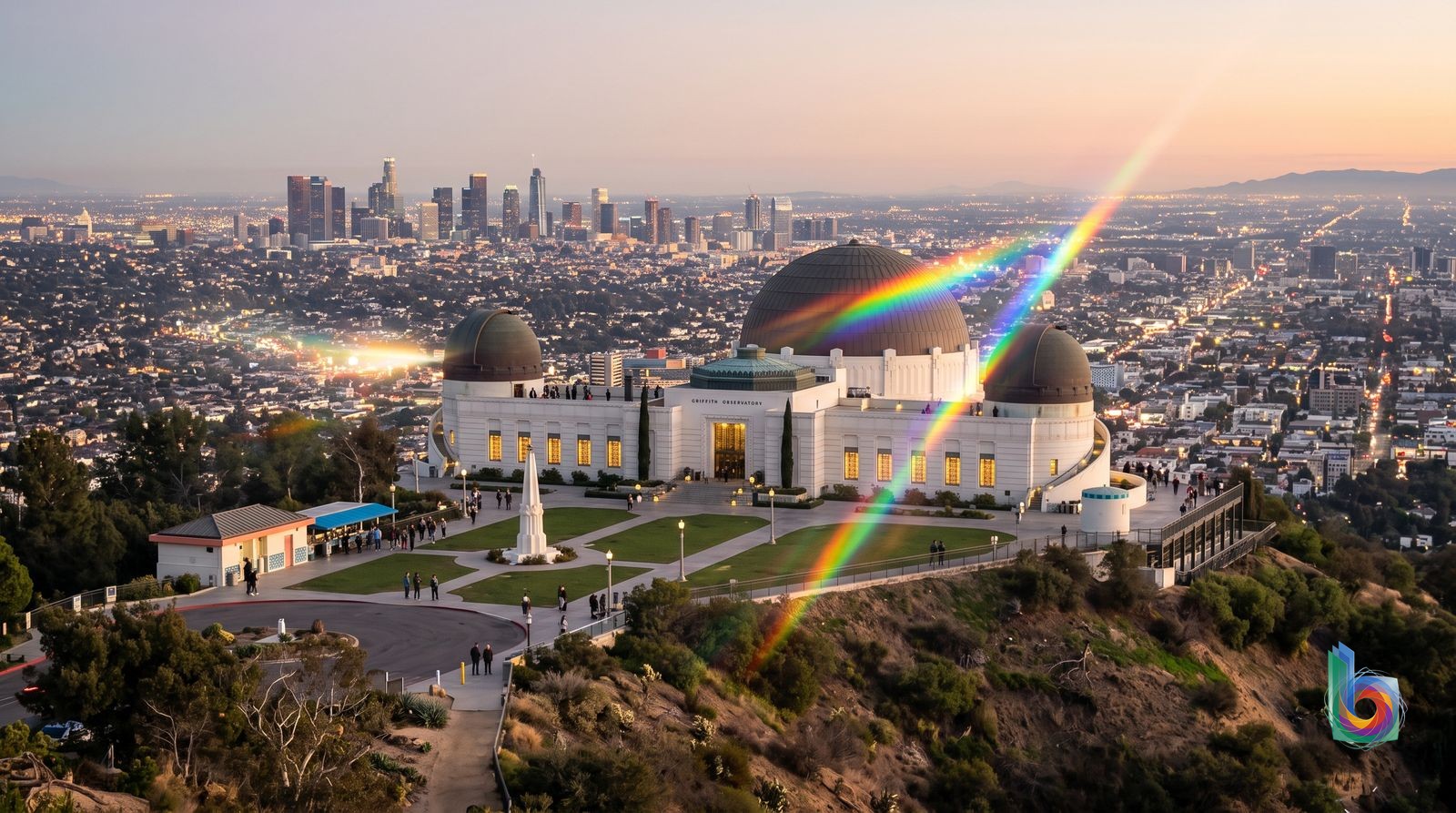
Griffith Observatory
Hollywood · 1.5 h
This is L.A.'s essential overlook: an Art Deco film icon, usable observatory, and a clear orientation point for the basin. Go late afternoon, see the exhibits if open, then stay through sunset and city lights.
Los Angeles is not a single, legible city so much as the economic and cultural capital of Southern California: a vast basin of fiercely distinct neighborhoods and independent cities, tied together by freeways, film and television, music, migration, trade, and the Pacific. Hollywood is its most exportable myth, but the real city is equally Korean, Mexican, Black, Armenian, Salvadoran, Iranian, Filipino and more—found in restaurants, streetscapes and everyday life from Koreatown to the San Fernando Valley and the Eastside. The trap is treating it as a compact Hollywood-and-beach break: that route delivers crowds, traffic and a thin version of L.A.; choose two or three adjacent areas and let the city reveal itself locally.
Locals navigate by regions rather than a center: Downtown (DTLA), Hollywood, the Westside, the beach cities, Mid-City/Koreatown, the Eastside, South L.A., the San Fernando Valley and the San Gabriel Valley. The Santa Monica Mountains divide the Valley from the central basin; the coast is its own world, and many places visitors call “L.A.”—Santa Monica, Beverly Hills, West Hollywood, Pasadena, Burbank and Long Beach—are separate municipalities. Think in travel corridors, not straight-line distance: crossing the city can consume a large part of a day.
Plan one major anchor sight or museum, plus one neighborhood or beach area, per day; two major anchors work only when they are close together or connected by Metro. L.A.'s attractions are scattered, traffic is unpredictable, and even good rail coverage is strongest on a few useful corridors rather than everywhere visitors want to go. A Getty Center morning and Santa Monica afternoon is sensible; Universal Studios, Venice and Downtown on the same day is not.
Hollywood · 1.5 h
This is L.A.'s essential overlook: an Art Deco film icon, usable observatory, and a clear orientation point for the basin. Go late afternoon, see the exhibits if open, then stay through sunset and city lights.
3 h
The Getty Center earns its place for strong European art, architecture, gardens, and an unusually expansive view across Los Angeles to the ocean. Give it a deliberate half-day rather than treating it as a quick photo stop.
Universal City, Studio City and Burbank · 8 h
This is the high-energy choice for visitors who want Hollywood spectacle translated into a major theme-park day, with the studio setting adding genuine local context. It is worthwhile if rides and immersive entertainment are a priority; it is not a substitute for seeing the city itself.
Santa Monica · 1.5 h
The pier is unabashedly touristy, but it is also the classic Pacific-end-of-L.A. experience: beach, amusement rides, ocean light, and easy people-watching. Pair it with the sand and neighboring streets rather than lingering only for the midway.
Hollywood · 45 min
You do not need to reach the letters to have seen the sign well; the better experience is selecting a viewpoint or hike that also gives you the surrounding hills and city. Treat it as a visual landmark, not a destination with an on-site visitor center.
Fairfax, Miracle Mile and Museum Row · 3 h
LACMA is the city’s broad, dependable art-museum stop, with collections that reward both first-time visitors and serious museumgoers. It is especially useful as the anchor for a Museum Row half-day.
morning
Hollywood · 45 min
midday
Hollywood · 40 min
afternoon
Hollywood · 45 min
evening
Hollywood · 1h 30m
Central, walkable, late-night, polished
Best forfirst-timers · nightlife
Skip ifbudget travelers · families wanting a beach
Beach base with real walkability
Best forfamilies · luxury
Skip ifvalue travelers · travelers focused on Hollywood or Universal Studios
Museums, rail hub, urban contrast
Best forrail-day-trips · foodies
Skip iffamilies wanting an easy resort-like stay · travelers uncomfortable navigating block-by-block conditions
Where to eat
December–February
Usually mild by cold-weather-city standards, but this is Los Angeles’s rainiest stretch. Storms can disrupt beach plans, hikes and traffic; clear days after rain can be exceptionally good for views.
Watch for Pack rain gear and do not build a tight outdoor itinerary around a forecast. Major awards weekends can sharply distort Hollywood-area hotels, traffic and access.
| Per person | Typical | High |
|---|---|---|
| One experience | $162 | $363 |
| A day | $162 | $363 |
Costs nothing
Safety: Use normal big-city judgment after dark, avoid Skid Row and unfamiliar Downtown industrial blocks, and never leave anything visible in a parked car—smash-and-grab theft is the most practical visitor risk.
Eat
Eat L.A. by neighborhood, not by a single “best restaurant” list: Korean barbecue and late-night soups in Koreatown; Mexican, Armenian, Salvadoran, Iranian and Filipino food across the Eastside, Valley and wider basin; and Japanese institutions in Little Tokyo. DTLA is strongest for a concentrated food day—especially Grand Central Market, Little Tokyo and the Arts District—while West Hollywood, Culver City, Los Feliz/Silver Lake/Echo Park and Pasadena are good choices for polished or indie neighborhood dinners. Santa Monica and Venice can be enjoyable for a meal near the water, but their most visible strips are pricier and more tourist-driven than the city’s deepest food districts.
Mexican food, especially tacos and the everyday taqueria tradition · Korean barbecue: a group meal built around grilling at the table, banchan and soju · Korean soups, noodles and late-night dining in Koreatown · Korean bakery culture—sweet and savory breads, cakes and coffee as much as a quick breakfast · Japanese food in historic Little Tokyo · Armenian, Salvadoran, Iranian and Filipino cooking, best approached as part of L.A.’s immigrant-led regional food culture rather than a novelty meal · Farmers-market grazing: Grand Central Market downtown and the Original Farmers Market in Fairfax are useful, varied stops rather than substitutes for neighborhood eating · A long, informal dinner followed by karaoke, dessert or another round is a particularly L.A. Koreatown rhythm
Before you go
Give Los Angeles at least four full days; five is better if you want a beach day, a studio or theme-park day, and museums without spending every day in transit. Plan one major anchor and one nearby neighborhood or beach per day, rather than trying to cover Hollywood, the coast and Downtown in a single sweep.
Choose one base according to your priorities: Santa Monica or the Westside for beaches; Hollywood or Los Feliz for studio access, Griffith and nightlife; Downtown or the Arts District for museums, food and transit; Pasadena for a calmer, attractive base with good rail access. Do not pick a hotel solely because it says “Los Angeles”—the city is too spread out for one location to be convenient for everything.
Not if your trip is focused on Downtown, Hollywood/Universal, Koreatown, Culver City and Santa Monica: Metro Rail plus selective rideshares can work well. Rent one only for a plan centered on Malibu, the Valley, Orange County, trailheads or day trips, and confirm hotel parking; traffic, parking and smash-and-grab risk are real downsides.
Reserve Getty Villa timed entry as soon as your date is firm, and book The Broad about one to two weeks ahead for weekend slots. Also book Warner Bros. Studio Tour Hollywood, date-specific Universal Studios tickets for busy dates, and desirable Hollywood Bowl concerts or Dodgers games as soon as schedules and plans align.
For Downtown or Union Station, take the nonstop LAX FlyAway: it is roughly 35–60 minutes when traffic cooperates and about $9.75. For Hollywood, Santa Monica or the Westside, compare rideshare pricing and traffic before booking—LAX pickup congestion can make a short-looking trip take an hour.
March through May and late September through November offer the best balance of mild weather and manageable crowds. Summer is best for beach and outdoor-event energy but brings bigger crowds, cool gray coastal mornings and much hotter inland temperatures; winter is mild but the rainiest season.
Avoid major awards-season weekends in Hollywood unless that is the point of your trip, since hotels, security closures and traffic can overwhelm the area. In early fall, check wildfire and air-quality conditions before committing to hikes or outdoor-heavy days; September and October can be extremely hot and smoky.
Yes, but only if you build days around Metro corridors: the B Line is useful for Downtown, Hollywood and Universal; the E Line links Downtown, Culver City and Santa Monica; the A Line serves Pasadena and Long Beach. It is not a citywide substitute for a car or rideshare—West Hollywood, Venice, Beverly Hills, Griffith Observatory and much of the hills remain awkward.
Trying to treat L.A. as a compact Hollywood-and-beach city. Keep each day geographically tight—Getty Center and Santa Monica is sensible; Universal, Venice and Downtown in one day is a traffic-heavy mistake.

Ready to go?
Plan a journey to Los Angeles
Start with this city already set as a chapter.
Destination profile
Worth knowing
Good to know