December–February
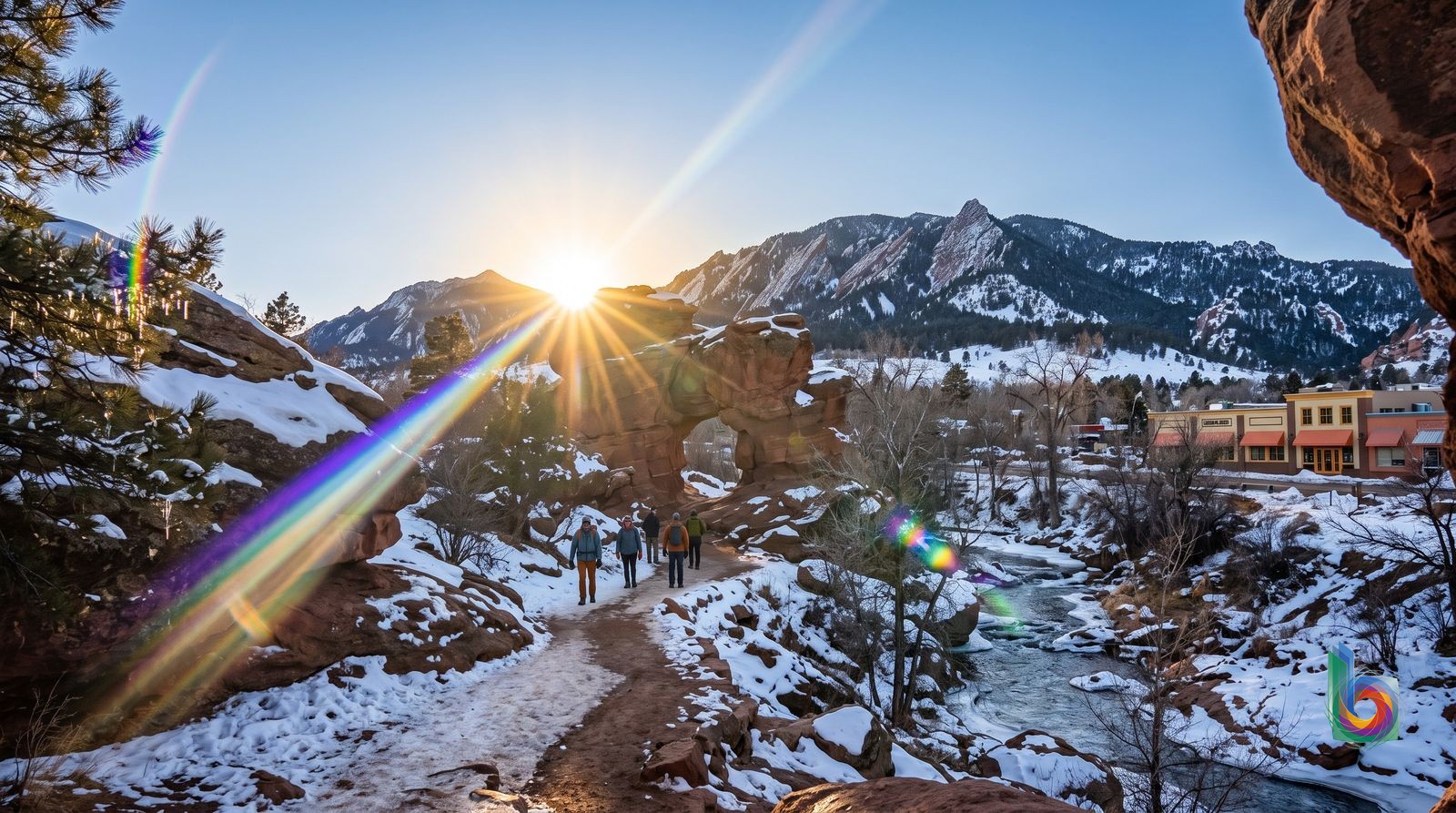
Quietest period, with cold nights, snow and ice possible, but many clear, sunny days. Pearl Street has fewer street performers, and ski-season weekends increase traffic on mountain roads.
Winter trail conditions can be icy, daylight is short, and mountain-bound traffic is heavier on ski weekends.
March–May
A volatile late-spring shoulder season: a single week can bring warm sun, snow and cold evenings. Conditions improve for walking and hiking, but do not mistake a warm afternoon for stable mountain weather.
Weather is the compromise; pack layers and be ready to change outdoor plans for snow, wind or a sharp evening temperature drop.
June–August
The most reliably summery period: hot, dry high-altitude sun, active Boulder Creek, and busy trails. This is Boulder at its most outdoors-oriented and crowded.
Popular trails are busiest, midday sun is intense, and lodging can be expensive. Start hikes early, hydrate aggressively and carry layers for after sunset.
September–October
The best all-round window: generally comfortable hiking weather, a more relaxed pace after peak summer, and fewer crowds than July and August.
CU football weekends can sharply raise hotel demand, worsen traffic and make restaurant reservations difficult.
November
A brief transition into winter, with colder evenings and increasing chances of snow or ice. The city is generally calmer than in summer or on football weekends.
Outdoor conditions are less dependable, daylight is shorter, and the fall hiking window is effectively winding down.
Colorado Buffaloes football at Folsom Field · Usually late August or September through November, on scheduled home-game weekends.
This is the recurring event most likely to reshape a Boulder trip. Major opponents and periods of heightened team demand can fill hotels, clog roads and make restaurants harder to book. Reserve lodging and game tickets as soon as dates are firm; avoid a home-game weekend if you want Boulder at an easier pace.
Walking
Downtown & Pearl Street Mall, CU’s pedestrian-centered campus, University Hill, and the Boulder Creek Path. Most signature visitor stops in the core fall within roughly 2 miles.
Base yourself downtown or near the Hill and treat Pearl Street, Walnut, campus, and the creek corridor as one walkable zone. Downtown to University Hill is about 1–1.5 miles; Chautauqua is a longer 30–45-minute walk from Pearl Street.
Walking stops being pleasant as a transport strategy in Chautauqua after a full sightseeing day, in North Boulder, South Boulder/Table Mesa, Twenty Ninth Street/East Boulder, and especially Gunbarrel. Mapleton Hill’s uphill grades are noticeable with luggage. Avoid solo late-night walks around the Hill; creek paths are quieter after dark.
Bicycle / e-bike
The best all-round way to stretch Boulder’s compact core: downtown, CU, University Hill, Boulder Creek Path, Central Boulder, North Boulder, and trips toward Chautauqua. It is often quicker than driving for short in-town hops.
Rent a bike or e-bike and use Boulder’s extensive path network, particularly the Boulder Creek Path. Ride predictably, signal, and treat the paths as transport corridors rather than leisurely promenades.
Do not block paths for photos or assume other riders are slow-moving tourists. Hills toward Chautauqua and Mapleton Hill favor an e-bike; weather, snow/ice, and darkness can make cycling a poor choice. Gunbarrel and South Boulder are feasible only for confident riders willing to cover longer distances.
RTD local bus
Car-free connections beyond the walkable core: downtown to CU/University Hill, Chautauqua, Twenty Ninth Street/East Boulder, North Boulder, and South Boulder/Table Mesa. It is also the practical connection from Denver and DEN into Boulder.
Use downtown as the hub: local RTD buses converge there, with frequent service along Broadway and other major corridors. For Denver Union Station, take the Flatiron Flyer to Boulder Transit Center; from Denver International Airport, take the direct AB bus.
Boulder has no in-town rail and buses are not a dense, late-night metro network. Chautauqua is less conveniently served than downtown, while residential Mapleton Hill streets, North Boulder side streets, South Boulder, and Gunbarrel require more route planning. Check the live schedule rather than assuming evening frequency.
Rideshare / taxi
A one-way return from Chautauqua after hiking, late-night travel when buses thin out, trips between dispersed East Boulder hotels and downtown, or avoiding a DUI after brewery-hopping or dinner.
Use it selectively rather than as your default downtown transport; in the Pearl Street–CU core, walking is usually easier. It is also sensible for a trailhead trip when you do not want to deal with parking.
Costs add up quickly, especially from Gunbarrel or South Boulder/Table Mesa, and availability can be less immediate outside the central districts or late at night. It is not a substitute for a car on a mountain day trip with multiple trailheads.
Rental car / driving
Trailheads and mountain day trips, families carrying gear, and stays in car-oriented Twenty Ninth Street/East Boulder, South Boulder/Table Mesa, or Gunbarrel. It is useful outside Boulder, not within its visitor core.
Park once when visiting downtown and walk from there. Use a car for the Flatirons only when you are prepared for busy trailhead parking, and for destinations beyond town where buses are impractical.
Driving downtown is more trouble than freedom: main arteries are busy, parking is tight, and cyclists and pedestrians are everywhere. CU and school-zone enforcement is strict; watch active flashing school-zone signals and the 20-mph limit. Never drive after drinking—DUI enforcement is vigilant.
Safety: Boulder is generally low-crime, but use normal city awareness after dark—especially around University Hill and Pearl Street—while treating altitude, sudden trail weather, wildlife and fast-moving bikes as the bigger day-to-day risks.
Book before you land
Rocky Mountain National Park via Estes ParkFull day — realistically 9–12 hours door to door, longer on summer or fall-color weekends.
This is the one indisputable full-day escape: proper high-country scenery, alpine lakes and trailheads that Boulder’s foothill parks cannot replicate. Go if you want mountains rather than another pleasant Boulder hike. A car is the practical choice; summer-season Bustang service via Boulder/Lyons is the car-free alternative, but it limits your flexibility. In peak season, check the park’s current timed-entry rules before committing.
Eldora Mountain Resort, near NederlandFull day — about 45–60 minutes each way by car from downtown Boulder, plus mountain-road/weather margin.
Worth leaving Boulder for if you actually want to ski or snowboard: it is the closest lift-served resort, rather than an excuse to spend a day in a small mountain town. The trade-off is that Eldora is a medium-sized local hill, not a destination-scale Colorado resort, and weekend snow days can be busy. In ski season, the RTD N bus continues from Nederland to Eldora.
Nederland and the Peak to Peak countryHalf to full day — roughly 45–60 minutes each way by car; allow longer by seasonal bus.
Choose this for a short mountain-road reset: Nederland is a genuinely quirky little mountain town and the drive puts you into conifer forest and higher terrain quickly. It is not enough to displace a first Boulder day on its own; pair it with a hike, snow day at Eldora, or a continued drive toward Estes Park. The NB shuttle runs to Nederland in summer, making it one of the few plausible no-car escapes.
DenverFull day — allow about 1–1.5 hours each way from central Boulder once you include getting to/from stops and local connections.
Denver beats another Boulder day when your trip needs serious urban culture—major art museums, broader dining, music, and Union Station—rather than more breweries, campus and trails. It is not a mountain escape, and driving/parking downtown is needless friction: take the Flatiron Flyer to Denver, then use RTD rail or walk.
Eldorado Canyon State ParkHalf day — about 25–40 minutes each way by car from downtown Boulder, plus time for parking and walking.
A much sharper, narrower landscape than Boulder’s open foothills: sheer canyon walls, Boulder Creek and one of Colorado’s great climbing settings. It is the best near-town choice for visitors who want scenery without committing to Rocky Mountain National Park. It can feel crowded and parking-constrained, so it is poor as a spontaneous late-morning weekend plan.
Researched Oct 24, 2026