Season by season
January–March
Kona remains sunnier and drier than much of Hawaiʻi Island, but winter brings the greatest weather variability and larger surf. It is a popular escape-from-winter period.
Expect higher demand than shoulder periods, and do not assume every beach or snorkel site will be calm; winter surf can limit ocean activities.
April–June
The best all-round shoulder season: reliably sunny, generally dry Kona weather with thinner crowds, especially from April through early June. Hurricane season officially begins in June.
By late June, temperatures rise and the official June–November hurricane season is underway, even though storms are not a certainty.
July–August
This is the warmest part of the year, with plenty of sun and a busy summer-travel atmosphere. Ocean tours and popular activities can book ahead.
Heat, holiday/summer demand and the ongoing hurricane season are the compromises. Reserve sought-after boat trips and manta tours several weeks ahead.
September–December
September through early December is another strong lower-crowd window, still warm and usually dry in Kona. Winter variability gradually returns later in the period.
Hurricane season runs through November. October can be a terrible time for an unplanned stay during Ironman World Championship week, when lodging, roads and access around town are heavily affected; late December also brings holiday demand and more winter-like ocean variability.
Events worth planning around
Ironman World Championship · Usually October, when Kailua-Kona is a host location; confirm the year’s host format and exact race week before booking.
This is the one event that can materially reshape a Kona trip: accommodations tighten and become expensive, roads and access around Kailua Village/Aliʻi Drive are affected, and restaurants and tours fill. Do not treat it as an ordinary October week; book far ahead or choose different dates.
Getting around
Walking
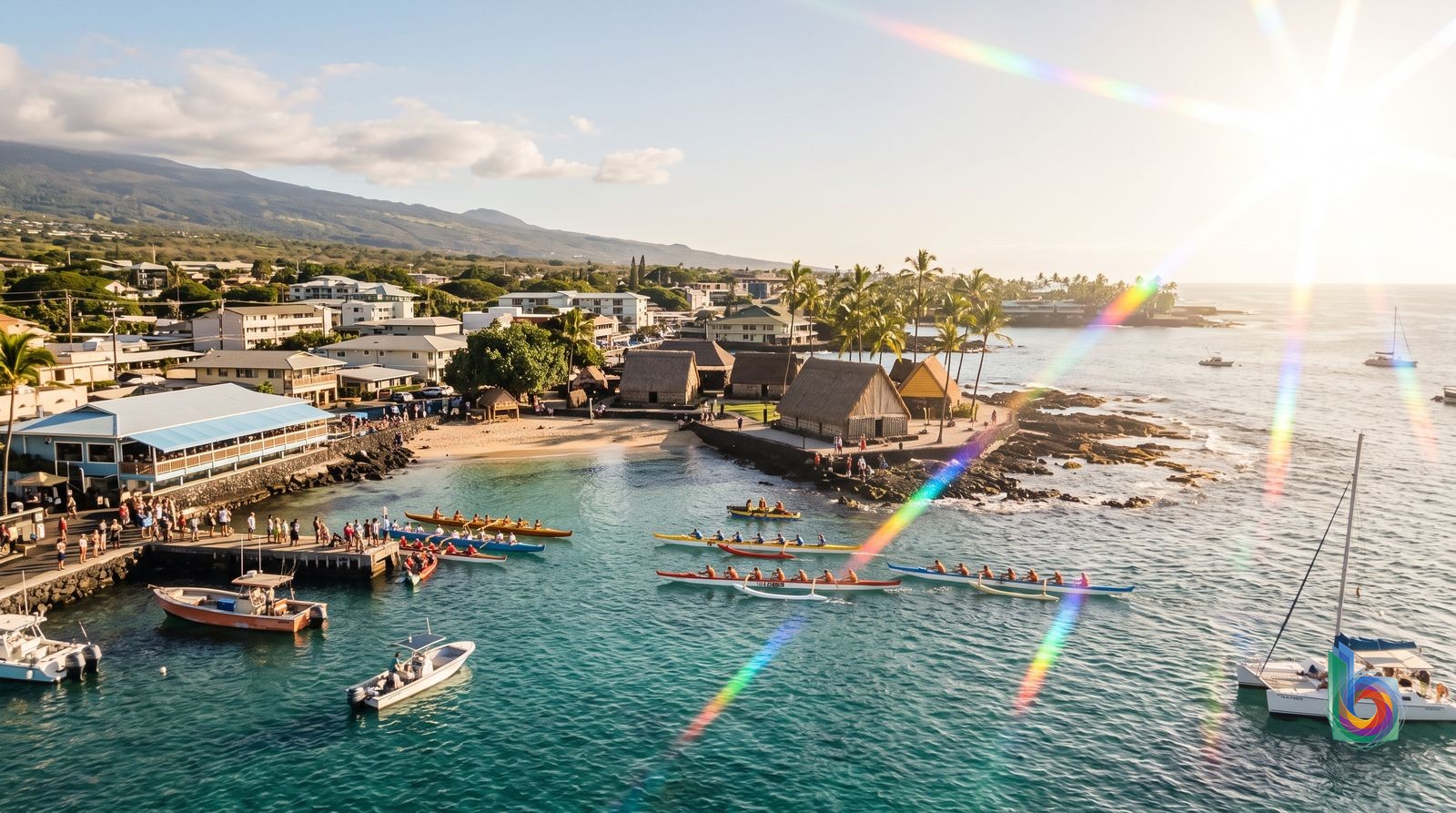
Kona Village (Downtown Kailua-Kona) for the Aliʻi Drive waterfront between Kamakahonu/King Kam Beach, Huliheʻe Palace, Mokuaikaua Church, the pier and restaurants; also for short outings within compact Kahaluʻu Beach.
Choose a Kona Village hotel if you want a genuinely car-light first day or two. Walk the historic waterfront rather than hunting for parking, especially around the pier.
Walking stops working well beyond downtown. Aliʻi Drive South is long rather than strollable end to end; Keauhou is spread out; Honokōhau Harbor, Kaloko, Holualoa and the airport-side Kaiminani district are car territory. Heat, little shade, inconsistent sidewalks and lava-rock coast make “nearby” distances less pleasant than they look.
Rental car
Anyone planning beaches beyond their hotel, coffee farms and Holualoa, Kaloko-Honokōhau National Historical Park, Honokōhau Harbor departures, Keauhou activities, airport runs or any wider Big Island touring.
Pre-book one, particularly if arriving through Kona airport. Use it for the essential gap between districts: Kona Village to Keauhou, Kahaluʻu, Kaloko/Honokōhau, Holualoa and Kaiminani are all practical drives, not useful transit links. Leave nothing visible in the vehicle at beach lots and trailheads.
It is the right tool, not a carefree one: Aliʻi Drive and highway approaches can crawl at peak times, and downtown parking can be irritating. Holualoa’s uphill roads are less relaxing after dark; do not book a rural or airport-area stay expecting to park once and walk everywhere.
Kona Trolley
A low-stakes ride between the Aliʻi Drive corridor—Kona Village, Aliʻi Drive South, Kahaluʻu and Keauhou—or for reaching the Old Industrial Area without driving yourself.
Treat the trolley as a convenient local connector with a nominal fare, useful when your plans already lie along its route. Check the current timetable and stops locally before timing a dinner, boat departure or airport connection around it.
It is not Kona’s answer to a city transit system. It does not solve airport transport, island exploration or practical access to Kaloko-Honokōhau National Historical Park and Honokōhau Harbor; it is also of little use for Holualoa. Service reach and frequency make it a poor fallback for late nights or fixed schedules.
Taxi or rideshare
Airport transfers when you have not rented a car, a one-way trip after drinks in Kona Village, or an occasional ride between a hotel and dinner, the pier or a nearby beach.
Use it selectively rather than building an itinerary around it. Arrange airport transport in advance for a late arrival if you are not collecting a car, and confirm pickup details for less central properties.
Repeated beach runs become expensive quickly, and taxis/rideshares cannot replace a car for a Big Island itinerary. They are an especially weak plan for remote-feeling districts and after-hours returns from Keauhou, Holualoa, Kaloko or the airport-side Kaiminani area.
Safety: Treat Kona’s ocean with respect: check conditions, avoid Kua Bay’s steep shorebreak when it is up, use lifeguarded beaches where possible, and give green sea turtles at least 20 ft (6 m) of space.
Book before you land
- Keep at least 20 ft/6 m from honu (green sea turtles) at Kaloko-Honokōhau and elsewhere. Do not touch, feed, crowd or position yourself between a turtle and the water.
- Ocean conditions—not your swimming confidence—set the rules. Kua Bay’s steep shorebreak can be dangerous, and conditions change quickly; use lifeguarded beaches when possible and do not enter surf simply because the water looks photogenic.
- Kona’s historic and cultural sites are not decorative backdrops. Stay on marked paths around heiau, fishponds and petroglyphs; do not climb on structures or move stones.
- A rental car needs nothing visible inside it, including at trailheads and beach lots. Bring water, sun protection and footwear; lava rock and hot pavement are harder on feet than visitors expect.
- Carry a card, but keep some cash for small independent vendors and tips. Hawaii is part of the U.S.: tipping is expected for sit-down service, guides and boat crews.
- For genuinely good free time, walk the Aliʻi Drive waterfront through historic Kailua Village; visit free Mokuaikaua Church; and spend time at free Kaloko-Honokōhau National Historical Park for fishtraps, trails and turtle viewing. Coffee farms such as Bayview Farms have offered free short tours and samples, but confirm before driving out.
Worth leaving the city for
Hawaiʻi Volcanoes National ParkFull day: allow 10–12 hours door-to-door from Kailua-Kona, including at least 4 hours of driving round-trip. A rental car is effectively essential.
This is the Big Island’s essential contrast to Kona: active volcanic landscapes, steam, crater walks and a climate that can feel like another island. It easily beats spending another day browsing Aliʻi Drive, but it is not a casual pop-over—conditions, including visible lava, change constantly.
Mauna Kea for sunset and stargazingFull afternoon and night: roughly 8–10 hours door-to-door from Kona. The summit route is not a routine rental-car excursion.
For sheer scale, nothing from town competes with being above the clouds on Hawaiʻi’s highest summit and then seeing the night sky from the visitor-information-station area. It is a big, cold, altitude-heavy outing rather than a beach day; use a reputable guided trip unless you are genuinely equipped and comfortable with the mountain drive.
South Kona: Kealakekua Bay and Puʻuhonua o Hōnaunau National Historical ParkFull day, or a substantial half day if you skip a water activity: around 6–8 hours door-to-door. Kealakekua Bay is best approached by a booked boat/kayak outing or viewed from shore; do not assume you can simply drive to the monument.
Make this one deliberate South Kona day rather than treating it as two separate drives. Kealakekua Bay offers protected-water snorkeling and the Cook-history landscape; Puʻuhonua o Hōnaunau adds the island’s most compelling accessible Hawaiian cultural setting—temple platforms, fishponds and a coastal archaeological trail. It has more substance than another afternoon in Kona Town.
Kona coffee country around Captain CookHalf day on its own, or add 2–3 hours to the Kealakekua Bay/Puʻuhonua day. Allow about 45–60 minutes each way from central Kailua-Kona, depending on the farm.
The slopes above South Kona explain what ‘Kona coffee’ actually means better than any downtown souvenir shop: working farms, tastings and broad coast views. Pair a plantation visit with the South Kona historic sites rather than making it a stand-alone all-day mission. Bayview Farms is one evidence-backed option with a short free tour and samples.