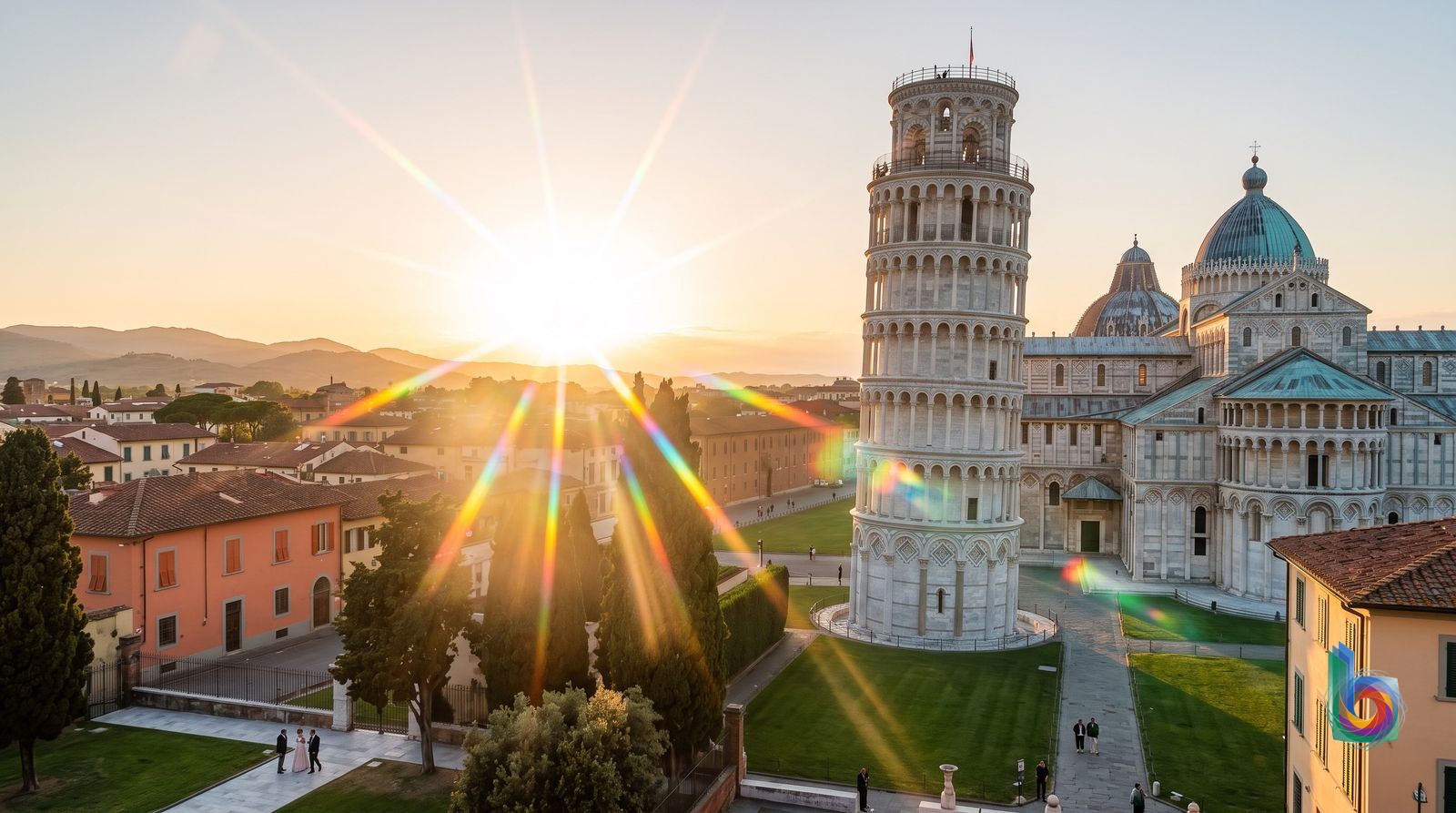
Season by season
December–February
Generally mild by northern-European standards, quiet and wetter, with short daylight and reduced/seasonal sightseeing hours. Snow is rare.
It is not reliable outdoor-sightseeing weather, and short days plus holiday/seasonal hours make a rushed day trip less rewarding. Check opening hours before committing to a same-day visit.
March
A transition month: cooler and more changeable than the prime spring window, but with lengthening daylight and usually fewer visitors than later spring.
Rain and cool spells remain possible, and it lacks the consistently mild conditions of April–June.
April–June
One of Pisa’s best periods: mild walking weather, longer days and a lively city without the full force of summer heat. Late June is especially event-heavy.
Spring weekends and the Tower’s timed entries can be busy, so reserve the Leaning Tower several weeks ahead once dates are firm. Around 16 June and the last Sunday of June, central-riverfront crowds and closures are substantial.
July–August
Often hot, humid and dry. The Campo dei Miracoli is very exposed, with little shade, and day-tripper numbers are high.
This is Pisa at its least comfortable for all-day walking. Visit the Piazza early or late, carry water and sun protection, and expect the Tower area to feel crowded.
September–October
The other prime window: generally pleasant walking weather, a lively atmosphere and less punishing heat than high summer.
Popular weekends can still be busy, and autumn rain becomes more likely toward October; book the Tower ahead for weekends and firm dates.
November
A quieter late-autumn month with cooler, wetter and shorter days, approaching winter conditions.
Outdoor plans are weather-dependent, and shorter sightseeing hours can limit a tightly timed visit.
Events worth planning around
Luminara di San Ranieri · Around 16 June
The Arno embankments are transformed by the illumination and become exceptionally crowded. Book accommodation and dinner plans early if staying overnight, and expect the Lungarni to be difficult to navigate.
Gioco del Ponte · Last Sunday in June
The parade and bridge contest bring street closures and heavy crowds along the Lungarni. Grandstand seats should be booked ahead only if the contest itself is a priority; otherwise watch the free parade from the riverfront and avoid battling for stand views.
Getting around
Walking
Nearly all sightseeing in Santa Maria & Piazza dei Miracoli, the Lungarni, Borgo Stretto & Corso Italia, San Francesco and San Martino. The roughly 30-minute route from Pisa Centrale to Campo dei Miracoli via Corso Italia, Borgo Stretto and Piazza dei Cavalieri is the right first orientation.
Treat the compact historic center as a walking city: Pisa Centrale to the Lungarni takes about 10–15 minutes, and the Tower is roughly 15–25 minutes from the river depending on where you cross.
Walking stops being efficient in Cisanello, San Giusto & Pisa Airport, Marina di Pisa and San Giuliano Terme & the Pisa Hills. The Tower is also a 25–30-minute walk from Pisa Centrale or Sant’Antonio with luggage, so use LAM Rossa instead.
LAM Rossa bus
The one city bus route visitors should know: it connects Pisa Centrale, the Lungarni and Piazza dei Miracoli. It is especially useful for the station-to-Tower run with bags, or for avoiding a final long walk after a full day.
Buy a city ticket before boarding where possible: it is about €1.50, valid for 70 minutes, and must be validated on entry. The onboard fare is higher, about €2.50.
Service thins after roughly 18:00, so do not build a late dinner or return from the Tower around it. It is not a solution for Marina di Pisa, San Giuliano Terme & the Pisa Hills, or most of Cisanello’s outer areas; those places need their own bus connection, a taxi or a car.
Train
Day trips and regional hops, not movement within the old center. Pisa Centrale is the useful main hub for Florence, Lucca, Livorno and the coast; Pisa San Rossore is the smarter arrival point if Piazza dei Miracoli is your first stop or hotel base.
Use Pisa Centrale for most arrivals and onward journeys. Use San Rossore only for the Lucca/Pistoia branch and the Tower side of town; many longer-distance trips require a change at Centrale.
San Rossore has much less service than Centrale, with at least hourly trains on its branch. Rail does not solve access to Cisanello, Marina di Pisa or the Pisa Hills, and a coach to Florence is less convenient than the train.
Pisamover airport people-mover
A fast airport-to-rail-station transfer when you are continuing from Pisa Centrale by train, or staying immediately around Sant’Antonio and the station.
It runs between Pisa International Airport and Pisa Centrale in about five minutes, roughly every 5–8 minutes from around 06:00 to midnight. The fare is about €6.50.
It is poor value for a solo traveler headed to the Tower or the north side of town. By day, walk 5–10 minutes from the airport to Via Sant’Agostino and take LAM Verde; Line 21 is the evening alternative, using the cheaper city ticket. It is not useful after its late-night operating window.
Taxi
Late airport arrivals, travelers with heavy luggage, families or groups of three or more, and trips when buses have thinned out. It is also a sensible fallback for Cisanello, San Giusto & Pisa Airport, Marina di Pisa and San Giuliano Terme after central transport becomes inconvenient.
Use official taxis, particularly from the airport and station ranks. Airport-to-town trips are roughly €10–20; split between three people, that can beat three Pisamover fares.
For routine sightseeing in Santa Maria, the Lungarni, Borgo Stretto or San Francesco, a taxi is slower and less useful than walking. The immediate Pisa Centrale area deserves ordinary late-night awareness, but not an automatic taxi ride for a daytime walk.
Car, rental car and scooters
Rent a car only after your city stay, for hill villages, the countryside around San Giuliano Terme, or when Cisanello parking and an out-of-town itinerary genuinely matter. App scooters are an optional short-hop tool rather than a core Pisa strategy.
If hiring a car, collect it at the airport when leaving Pisa rather than bringing it into the historic center. Keep the city portion of the trip car-free.
Do not drive in the center: pedestrian streets, one-way lanes, poor parking and camera-enforced ZTL restrictions make accidental entry easy. Scooters are a marginal choice in Santa Maria, Borgo Stretto and San Francesco because cobbles, crowds and narrow lanes erase their advantage; neither car nor scooter fixes the late-night transport gap as cleanly as a taxi.
Safety: Pisa is broadly safe, but around Pisa Centrale late at night and in the Tower crowds keep your phone and wallet secure, and ignore unlicensed souvenir sellers—counterfeit purchases can carry hefty fines.
Book before you land
- The Campo dei Miracoli is Pisa’s headline, not its whole identity. Allow a realistic half-day there—especially if climbing the Tower—then walk south through Piazza dei Cavalieri, Borgo Stretto and the Arno Lungarni. The student city begins once the souvenir stalls stop.
- Carry water and sun protection at the Piazza: the lawn-and-marble complex is exposed, and the city-walls walk has essentially no shade either.
- Buy bus tickets before boarding where possible and validate them when you enter. The onboard fare is higher (about €2.50 versus €1.50).
- Pisa is broadly safe, but treat the station area more cautiously late at night and keep phones/wallets secure in the Tower crowds and on busy pedestrian streets.
- Ignore unlicensed sellers around the Tower, particularly sellers carrying goods in sacks or on cardboard. Counterfeit goods are not a harmless bargain: buyers can face substantial fines. Use permitted stalls if you want a souvenir.
- A taxi from the airport to Centrale is not automatically a rip-off for a group: split three ways, it can cost less than three Pisamover tickets. Solo travellers should use public transport.
Worth leaving the city for
LuccaHalf day at a squeeze; realistically 6–8 hours door to door by train from Pisa Centrale.
The best easy escape from Pisa: a complete walled city with a far more satisfying all-day historic-centre wander. Walk or cycle the Renaissance walls, then work inward through its lanes and piazzas. It beats a second or third Pisa day unless you are specifically interested in Pisa’s university quarter and Arno-side churches.
FlorenceFull day; allow roughly 9–11 hours door to door, including the train and walking/queues.
Go for the concentrated weight of Renaissance art and architecture that Pisa simply cannot match. This is not a casual add-on—Florence deserves a committed day and pre-booking for its headline museums—but it is the clear choice if you have only one extra day in Tuscany.
Cinque TerreFull day, typically 10–12 hours door to door with connections and inter-village trains.
Choose this only when you want sea, cliffside villages and coastal rail scenery rather than another Tuscan town. From Pisa it is feasible by train via La Spezia, but it is a long, crowded day in peak season and not the clever choice for anyone who dislikes transit or tourist crushes.