- Pace
- For a first visit, use one hotel in Osaka City: Namba for food, nightlife and easy KIX access, or Umeda for calmer hotels and stronger links north. Give the central city at least three full days, or four to five if food, shopping, museums and a major theme park matter; add a separate day each for Sakai, north Osaka or southern Senshu. Sakai takes roughly 20–35 minutes from the city, Kishiwada 45–60 minutes, and Minoh or Expo ’70 Park commonly 45–60 minutes in real door-to-door time, so do not casually combine north and south Osaka in one day.
- When to go
- Mid-April to late May and October to November are Osaka’s best all-round windows: walkable weather, long enough days and the easiest conditions for combining the city with Sakai or north Osaka. Summer is brutally humid but works for night eating, indoor attractions and Tenjin Matsuri; winter is cool, comparatively cheap and good for city food trips, except around Christmas/New Year. Avoid building a rigid trip around cherry-blossom timing, and book early for Golden Week, Tenjin Matsuri and Kishiwada Danjiri Matsuri.
- Daily budget
- ¥25,000–¥45,000
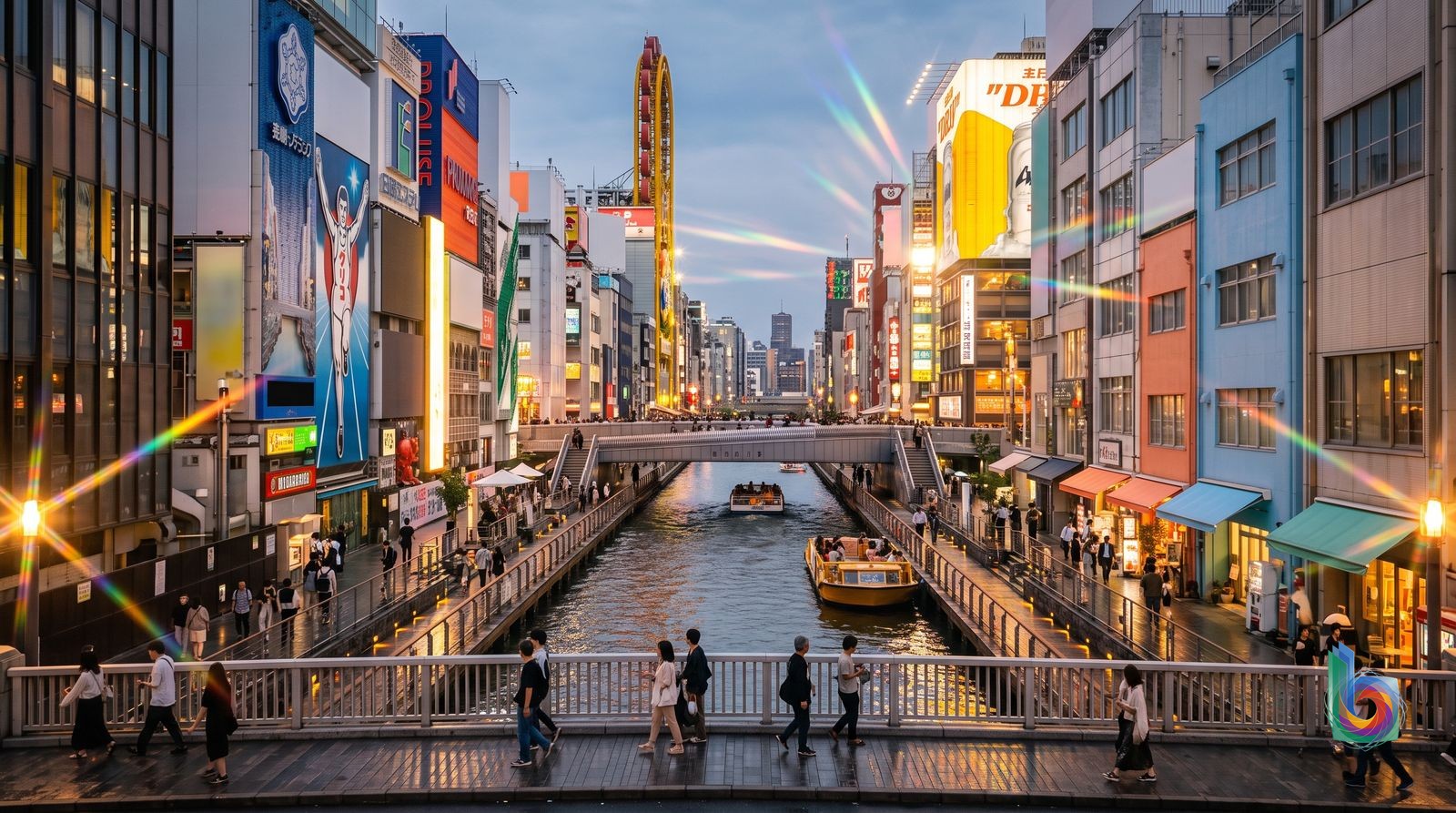
Osaka Prefecture is Japan’s compact, densely populated mercantile heartland: a loud, food-obsessed metropolis at its center, backed by former port and craft towns, northern suburban foothills, and a surprisingly rural southeast. Beyond the neon, it is a place for eating broadly and casually, using excellent rail links, and finding sharp contrasts between central-city velocity and quieter temple, tomb, market and walking country.
Known for
- Kuidaore food culture: takoyaki, okonomiyaki, kushikatsu, dashi and informal drinking
- Osaka’s direct, convivial mercantile character, comedy and nightlife
- Universal Studios Japan and Kaiyukan aquarium
- Osaka Castle and the city’s dense rail-linked urban districts
- Sakai’s burial mounds, knife craft, tea and incense traditions
- Kishiwada Danjiri Matsuri and the quieter towns of southern Osaka
Where to go
 1
Base · 2–4 days
Osaka City
The essential first-stop city: base yourself in Namba for food and late nights or Umeda for smoother rail connections. It covers Minami’s neon and snack culture, Tennoji and Shinsekai, Osaka Castle, Nakanoshima museums, and the separate-purpose Osaka Bay attractions.
first-timersfoodiesnightlifefamilies
Explore Osaka City  2
Osaka Bay
Short stop · 1 day
Come with a specific objective: Universal Studios Japan needs a full day, while Kaiyukan makes a strong wet-weather or family day. This is an entertainment waterfront, not a scenic seaside district to wander.
familiestheme-park fansaquarium visitors
 3
Sakai
Short stop · 1 day
A quieter, more thoughtful counterweight to central Osaka, with the Mozu burial-mound landscape, knife and incense crafts, tea culture, and old merchant streets. Give it a half-day at minimum; the appeal is the accumulated landscape rather than one dramatic sight.
history travelersdesign loversfoodies
North Osaka Foothills
4North Osaka Foothills
Short stop · 1 day
The practical nature reset: Minoh’s waterfall walk and Ikeda’s small museums trade neon for leafy suburban hills. It works best as a single unhurried day from Osaka City, especially in autumn.
walkersfamiliesautumn travelers
Suita and Expo ’70 Park
5Suita and Expo ’70 Park
Short stop · 1 day
Go for Expo ’70 Commemorative Park, the Tower of the Sun, and one of the prefecture’s best large green spaces. It is particularly worthwhile for architecture-minded visitors and families, but do not bolt it onto a busy central-city day.
architecture fansfamiliespark lovers
Yamazaki and Shimamoto
6Yamazaki and Shimamoto
A northeastern edge-of-prefecture outing centered on Suntory’s Yamazaki Distillery and the surrounding low-key river-and-mountain setting. Only build a day around it after securing a distillery reservation; it is not a casual drop-in.
whisky enthusiastsfoodiesrepeat visitors
Kishiwada and the Senshu Coast
7Kishiwada and the Senshu Coast
Short stop · 1 day
A former castle-town and coastal stretch with a fiercely local identity, best known for Kishiwada’s Danjiri Matsuri. Outside festival season, visit for the castle, Danjiri Kaikan, old streets, and a distinctly non-central-Osaka day trip.
festival travelersrepeat visitorslocal-culture seekers
Izumisano and Rinku Town
8Izumisano and Rinku Town
Short stop · 1 day
Use this airport-side coast for a low-stress KIX arrival or departure night, outlet shopping, or straightforward waterfront hotels. It is functional and convenient rather than a substitute for staying in Osaka City.
early flightsfamilies with luggageoutlet shoppers
Southeast Osaka
9Southeast Osaka
Short stop · 1 day
The slow, semi-rural Kawachi side of the prefecture, where Tondabayashi’s Jinaimachi merchant district and Kawachinagano’s temples replace city pace with old streets, farms, and low mountains. Allow extra time for buses and walking; this is a deliberate second-visit choice.
temple loversphotographershikers
Don't miss
1
Dotonbori
This is Osaka at its most theatrical: canal-side signs, snack stalls, crowds and late-night energy. Come after dark for the atmosphere, then use it as the anchor for an eating-and-walking circuit through central Osaka.
2
Umeda Sky Building
Its rooftop observatory gives the clearest big-picture view of Osaka's immense urban spread, rather than a view framed by nearby towers. It works especially well near sunset, with time afterward for Umeda's dining streets and underground arcades.
3
Osaka Castle
The reconstructed keep is more useful as an introduction to Osaka's political history and as a city icon than as an intact original castle experience. Combine its museum interior with a walk in the surrounding grounds rather than treating it as a quick photo stop.
4
Osaka Aquarium Kaiyukan
This is one of Japan's strongest large aquariums, designed around a gradual descent past habitats rather than disconnected tanks. It is a particularly good rainy-day or family choice, and makes sense with the waterfront attractions nearby.
5
Tsutenkaku
The tower is the visual emblem of Shinsekai, Osaka's retro, rough-edged entertainment quarter. The view is secondary to pairing it with a street-food wander through the surrounding neighborhood.
Getting your bearings
Numbers match the places above; small dots are the headline sights.
The mental map
Slice the prefecture into central Osaka City; north Osaka’s Suita, Minoh and Ikeda foothills; south Osaka/Sakai and the Senshu coast; and the semi-rural Kawachi southeast around Tondabayashi and Kawachinagano. Central Osaka is the real first-visit destination, while the outer areas are distinct day trips rather than extensions to tack onto a city day. Osaka Bay is mainly functional and entertainment-focused, except for the far-southern Misaki coast.
When to go
Mid-April to late May and October to November are Osaka’s best all-round windows: walkable weather, long enough days and the easiest conditions for combining the city with Sakai or north Osaka. Summer is brutally humid but works for night eating, indoor attractions and Tenjin Matsuri; winter is cool, comparatively cheap and good for city food trips, except around Christmas/New Year. Avoid building a rigid trip around cherry-blossom timing, and book early for Golden Week, Tenjin Matsuri and Kishiwada Danjiri Matsuri.
Pacing a visit
For a first visit, use one hotel in Osaka City: Namba for food, nightlife and easy KIX access, or Umeda for calmer hotels and stronger links north. Give the central city at least three full days, or four to five if food, shopping, museums and a major theme park matter; add a separate day each for Sakai, north Osaka or southern Senshu. Sakai takes roughly 20–35 minutes from the city, Kishiwada 45–60 minutes, and Minoh or Expo ’70 Park commonly 45–60 minutes in real door-to-door time, so do not casually combine north and south Osaka in one day.
Book before you land
Universal Studios Japan: book a date-specific Studio Pass in advance for busy dates; Express Passes regularly sell out and are the real priority if you dislike queues. · Suntory Yamazaki Distillery: tours are reservation-only and some are allocated by lottery; even shop and tasting-lounge access requires a reservation. · Kaiyukan Aquarium: reserve timed entry ahead for weekends, holidays and school-vacation periods, when same-day slots can mean long waits or disappear.
Getting in
KIXKansai International Airport (KIX), Izumisano
The main international gateway and the sensible airport for most Osaka stays. Nankai trains reach Namba in roughly 34–45 minutes; JR serves Tennoji and Osaka/Umeda. Use an airport-area hotel only for a very early departure or deliberately low-key final night.
Flights and transfers into IzumisanoITMOsaka Itami Airport
The useful domestic airport, despite its name being outside central Osaka. Airport buses are usually the least fiddly option to Umeda or Namba; it suits arrivals from elsewhere in Japan, not most international itineraries.
Flights and transfers into OsakaShin-Osaka Station
The Shinkansen gateway from Tokyo, Hiroshima, Fukuoka and beyond. It is excellent for onward travel but not a compelling hotel base: transfer to Umeda or Namba unless you have an early train.
Osaka/Umeda Station
The main conventional-rail hub for arrivals from Kyoto, Kobe, Nara and the wider Kansai region. Stay around Umeda for the easiest northbound and intercity rail connections; use Namba instead if evenings and KIX access matter more.
Before you go
Questions worth settling
How many days do I need for a first visit to Osaka Prefecture?
Allow at least three full days for Osaka City. Stay four to five days if food, shopping, museums and Universal Studios Japan matter, then add a separate day each for Sakai, north Osaka, or Kishiwada and the Senshu Coast.
Where should I stay: Namba, Umeda, or near the airport?
Stay in Namba for food, nightlife and the direct train from Kansai International Airport (KIX); choose Umeda for calmer hotels and easier rail connections north and to Kyoto, Kobe and Nara. Use Izumisano or Rinku Town only for an early KIX departure, a late arrival, or a deliberately low-key final night.
Which Osaka day trips can I combine, and which should be separate?
Treat each outer direction as its own day: Sakai, Minoh or Suita and Expo ’70 Park, Kishiwada, and Southeast Osaka all work best separately from Osaka City. Do not combine north Osaka with Kishiwada or the southern Senshu Coast in one day, despite the prefecture’s compact size.
Do I need a car to explore Osaka Prefecture?
No for Osaka City, Sakai, Kishiwada, Minoh and Expo ’70 Park: the rail and subway network is the practical choice, and a car is a liability in the city. Consider a rental car only for a slow trip around Tondabayashi and Kawachinagano in Southeast Osaka, where buses and dispersed temple sites add friction.
What is the best time of year to visit Osaka?
Mid-April to late May and October to November offer the best balance of comfortable walking weather and easy day trips to Sakai or the North Osaka Foothills. Summer is intensely hot and humid but suits night eating, Kaiyukan and Universal Studios Japan; book early for Golden Week, Tenjin Matsuri on July 24–25, and Kishiwada Danjiri Matsuri in September.
What should I book in advance?
Book Universal Studios Japan date-specific entry ahead on busy dates, and prioritize an Express Pass if avoiding queues matters. Reserve Kaiyukan timed entry for weekends, holidays and school vacations; Yamazaki Distillery visits require reservations, with some tours allocated by lottery.
Do I need a visa to visit Osaka, Japan?
Many passport holders, including citizens of the US, Canada, UK, EU countries, Australia and New Zealand, can generally visit Japan visa-free for tourism for up to 90 days. Requirements vary by nationality, so confirm visa, passport-validity and current entry procedures with an official Japanese embassy before booking.
Known for
- Kuidaore food culture: takoyaki, okonomiyaki, kushikatsu, dashi and informal drinking
- Osaka’s direct, convivial mercantile character, comedy and nightlife
- Universal Studios Japan and Kaiyukan aquarium
- Osaka Castle and the city’s dense rail-linked urban districts
- Sakai’s burial mounds, knife craft, tea and incense traditions
- Kishiwada Danjiri Matsuri and the quieter towns of southern Osaka