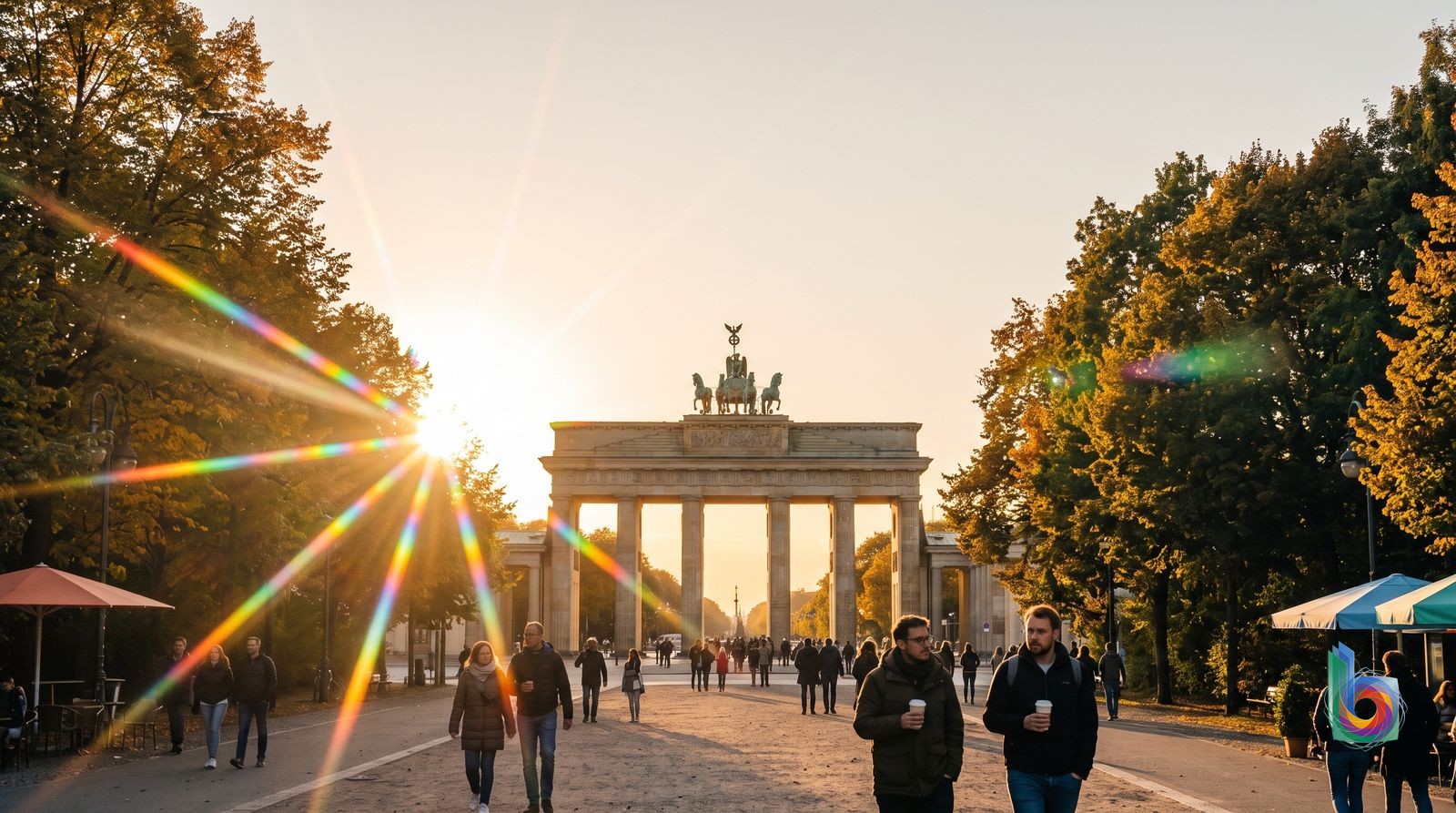
Season by season
January–February
Cold, often grey, with short daylight and occasional ice or snow. Indoor Berlin—museums, galleries, clubs and restaurants—works well; long sightseeing walks do not.
This is a poor choice for a first visit centred on parks, neighbourhood wandering and outdoor landmarks; weather can make the city feel austere.
March–April
A variable early spring: daylight improves, but cold snaps, wind and rain remain entirely possible. Outdoor café life begins tentatively rather than reliably.
Do not plan as if it will be warm. Easter-period demand can tighten accommodation and popular timed entries.
May–June
The year’s strongest all-round window: long days, generally tolerable temperatures and a Berlin made for walking, parks, beer gardens and sitting outside. Rain remains possible in any month.
May 1 materially changes the atmosphere in parts of Kreuzberg and Friedrichshain; avoid booking there for a quiet night unless you want the festivities and crowds.
July–August
Warmest period, with long daylight and abundant outdoor life, but occasional genuine heat. This is also Berlin’s busiest mainstream visitor season.
Expect the greatest hotel pressure, more visitors and less comfortable sightseeing during heatwaves. Reserve sought-after timed entries and desirable hotel rooms earlier.
September
Usually the best late-season compromise: pleasant walking weather, useful daylight and a more manageable feel than high summer, though rain is always possible.
It is popular for good reason, so weekends and well-located hotels can still be busy; it is not a bargain season.
October–November
Autumn turns cooler, wetter and darker, particularly by November. The city increasingly rewards an indoor-led plan.
Shortening daylight and unsettled weather make ambitious cross-city walking itineraries less appealing. November can feel notably grey.
Events worth planning around
May Day / 1 May festivities · May 1, especially from afternoon into the night
Festivities, demonstrations and occasional disorder concentrate around Oranienstraße and Mariannenplatz in Kreuzberg, with effects in parts of Friedrichshain and Prenzlauer Berg. It is lively if that is the point of the visit; otherwise avoid those areas that evening and do not book there expecting quiet.
Berlin Christmas-market season · Late November through December, varying by market and year
Central areas become markedly busier, and weekend accommodation prices and availability worsen. Book a well-located hotel and sought-after Fernsehturm slots earlier than usual; expect crowds around major markets rather than a quiet winter city break.
Getting around
U-Bahn and S-Bahn
The default for crossing Berlin: use it between Mitte, Alexanderplatz, City West/Charlottenburg, Kreuzberg, Neukölln and Friedrichshain. The S-Bahn Ring is the useful mental boundary for most first-trip sights; the U-Bahn is particularly dense in the west and inner city.
Use the BVG journey planner and buy one integrated ticket valid on U-Bahn, S-Bahn, trams, buses and local regional trains. At Hauptbahnhof, U5 is the simple link to Alexanderplatz; S3, S5, S7 and S9 cross the city. Validate paper tickets where required.
Berlin’s rail network is excellent but not door-to-door: Prenzlauer Berg relies heavily on trams beyond the U2 corridor, and northern Neukölln, Tempelhof, Treptow and Köpenick can mean a longer final leg. Large hubs—especially Alexanderplatz, Gesundbrunnen and Warschauer Straße—are less pleasant late at night; keep bags close.
Tram
The smartest surface transport in the east: Prenzlauer Berg, Friedrichshain, Alexanderplatz and the Hauptbahnhof direction. M1 and M10 are especially useful from Prenzlauer Berg, while M10 links Friedrichshain toward Prenzlauer Berg and Hauptbahnhof.
Treat trams as part of the same BVG ticket system, not a separate network. They are often the easiest way to avoid needless changes when travelling across eastern inner Berlin.
Trams are much less useful in Kreuzberg, Neukölln, Schöneberg and much of Charlottenburg, where the U-Bahn and buses do more of the work. They also stop being a dependable spontaneous option late at night compared with planning around rail or using a taxi.
Bus
Filling the gaps: useful for addresses away from stations, for parts of Moabit and Charlottenburg, and for reaching sights or hotels where the rail map looks close but the actual walk is not.
Plan the exact route in the BVG app rather than trying to decode the bus network on the street. Your normal integrated BVG ticket applies.
Buses are the mode most exposed to Berlin traffic, so they are a poor choice when you have a timed museum entry, train or flight. They are also slow for long cross-city rides; do not use one to stitch together an itinerary from Charlottenburg to Museum Island to East Side Gallery if rail is available.
Walking
Exploring within a district: Historic Mitte and Museum Island, the Brandenburg Gate–Reichstag–Holocaust Memorial area, Tiergarten, Kreuzberg’s canal streets, Prenzlauer Berg’s café squares, and the East Side Gallery riverfront all reward walking.
Build each day around two or three nearby clusters, then take transit between them. Berlin is essentially flat, so hills are not the problem; distance is.
Do not mistake ‘inside the Ring’ for compact. Museum Island, Charlottenburg, Kreuzberg and Friedrichshain are not a realistic single walking circuit. In winter, rain and early darkness make long walks less appealing. Stay out of marked cycle lanes: they are active transport lanes, not spare pavement.
Bike or bike-share
A good option for confident riders on a dry day, especially around Tempelhofer Feld, Tiergarten, the Landwehr Canal, Treptow’s riverside areas and the flatter eastern districts. It can make sprawling neighbourhoods feel much more manageable.
Use a reputable rental or bike-share for a local outing rather than assuming cycling is the best way to cover every major sight. Follow lane markings and park considerately.
Berlin is flat rather than hilly, but cycling is not frictionless: traffic, cobbles, weather and unfamiliar junctions can make it stressful. Avoid treating nightlife districts such as Kreuzberg, Friedrichshain and Neukölln as carefree late-night cycling territory; pedestrian and traffic conditions worsen after dark.
Taxi or ride-hailing
A backup for late-night returns, heavy luggage, mobility needs, or an awkward last leg away from a station—particularly in outer Treptow and Köpenick, or when a stay is labelled Neukölln, Tempelhof or Moabit but sits far from its useful transport spine.
Use it selectively rather than as the default system. It is also the sensible alternative if you arrive at an unfamiliar large station late at night and do not want a long walk through its immediate surroundings.
Traffic is increasingly bad and parking is a nuisance, so taxis are rarely faster than U-Bahn or S-Bahn across central Berlin. They are an expensive substitute for a network that already works well; do not rent a car for the city.
Safety: Berlin is broadly safe, but keep bags close on crowded trains and around Hauptbahnhof or Warschauer Straße late at night, and avoid May 1 crowds in Kreuzberg/Friedrichshain unless you want possible disturbance.
Book before you land
- Validate paper public-transport tickets before travel where required; inspectors are routine and the fine for an invalid ticket is far more expensive than the fare. For BER, buy ABC, not AB.
- Berlin is cash-friendlier than many European capitals, but cards are increasingly accepted. Carry a little cash anyway, especially for small independent bars, kiosks and market purchases; do not assume every counter takes a foreign card.
- Watch bags on crowded public transport and at major stations, especially Hauptbahnhof and Warschauer Straße late at night. Berlin is broadly safe, but it is a large city rather than a risk-free theme park.
- Bike lanes are transport lanes, not extra pavement. Check for cyclists before stepping across them, and do not stand in them while reading a map.
- May 1 is the one date to plan around: avoid the Oranienstraße/Mariannenplatz area of Kreuzberg and parts of Friedrichshain/Prenzlauer Berg from evening into the night if you do not specifically want the crowds and possible disturbance.
- Berliners are not rude for the sake of it, but service can be brisk and direct. A clear greeting, knowing your order before reaching the counter, and not blocking a doorway or escalator goes further than performative politeness.
Worth leaving the city for
Potsdam and SanssouciFull day; allow roughly 45–60 minutes door-to-door each way from central Berlin, plus substantial walking in the park.
The clear first choice: a real second city, not a commuter-town diversion. Sanssouci’s palace-and-park ensemble gives you the Prussian court world that Berlin itself only hints at, and Potsdam’s Dutch Quarter and lakeside setting make a welcome change from Berlin’s hard urban edges. Take S7 or RE1; it is close enough to do properly without turning the day into transit. Go on a weekday if possible—this is Berlin’s most obvious escape and it can feel busy.
Sachsenhausen Memorial, OranienburgHalf to full day; realistically 5–7 hours door-to-door, depending on how deeply you visit.
Go if you want historical understanding rather than another landmark. This is one of the few preserved Nazi concentration-camp sites in Germany, and its scale, prison buildings and grounds make it far more affecting than trying to assemble the story from city-centre plaques. It is not a cheerful outing and should not be rushed or paired with a casual sightseeing agenda. RE trains or the S1 reach Oranienburg in about 30 minutes from central Berlin; the memorial still requires a local walk or connection.
SpreewaldFull day; count on about 1–1.5 hours each way from central Berlin, plus time to reach the waterways from the station.
This is the trip that most decisively beats an additional museum day: a UNESCO biosphere reserve of canals, meadow and forest roughly an hour south of the capital. Take a punt-boat trip or rent a paddle craft and accept that the point is to slow down. It is strongest in warm weather; in cold rain, the pastoral magic largely disappears, and a full day in Berlin is the better call.
Lutherstadt WittenbergFull day; plan 7–9 hours door-to-door, including station transfers and time on foot.
Worth the longer rail ride for travelers interested in the Reformation: the Schlosskirche, associated with Martin Luther’s Ninety-five Theses, anchors an exceptionally walkable historic centre. It has a sharper single historical purpose than Potsdam and is less rewarding if church and intellectual history leave you cold. Fast ICE services can make the rail journey about 40 minutes, but check the specific train rather than assuming every departure is that quick.